Egyptian Actor Amir El-Masry cast in Netflix’s The Crown

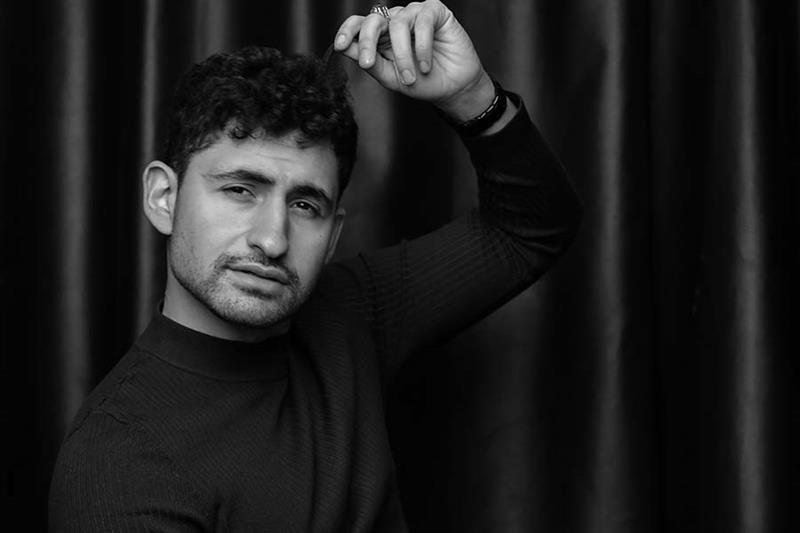
Egyptian actor Amir El-Masry was cast in the upcoming fifth season of Netflix’s historical drama The Crown, according to a PR representative on Wednesday.

El-Masry will portray the young Egyptian billionaire Mohamed Al-Fayed, Egyptian-born UK-based businessman, owner of Hôtel Ritz Paris and formerly Harrods department store and Fulham FC.

The cast of the fifth season also includes Egyptian-British actor Khalid Abdalla who has ben cast as Dodi Fayed , Mohamed Al-Fayed’s son and late Princess Diana’s boyfriend. Abdalla will play opposite Elizabeth Debicki as Diana.

Born in Cairo in 1990 and raised in London, El-Masry’s career kicked off with roles in Egyptian films, earning him Best Young Actor at the Egyptian Oscars in 2009.

Graduating from The London Academy of Music and Dramatic Art in 2013, Amir appeared in Jon Stewart’s debut feature Rosewater and various acclaimed TV series before his breakthrough role in The Night Manager (2016), followed by Lost in London (2017), The State (2017) and Age Before Beauty (2018).

Other notable credits include the critically acclaimed BAFTA nominated mini-series The State, a series regular role of Dante in the new BBC series Age Before Beauty and the lead in the first American-Saudi feature The Arabian Warrior.

Following the reign of Queen Elizabeth II, including political and romantic events that have shaped the twenty-first century, The Crown is considered one of the greatest series in the history of drama.

The series has won over 130 awards, including 21 Primetime Awards, of which seven were during the 73rd Primetime Emmy Awards in 2021, scooping awards of all categories. 

The first season of The Crown was released in November 2016. Its fifth season is scheduled for release in November 2022.

source/content: english.ahram.org.eg

____________

_______________________

BRITISH / EGYPTIAN

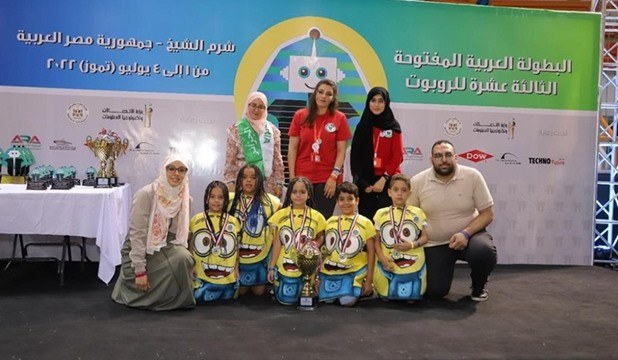
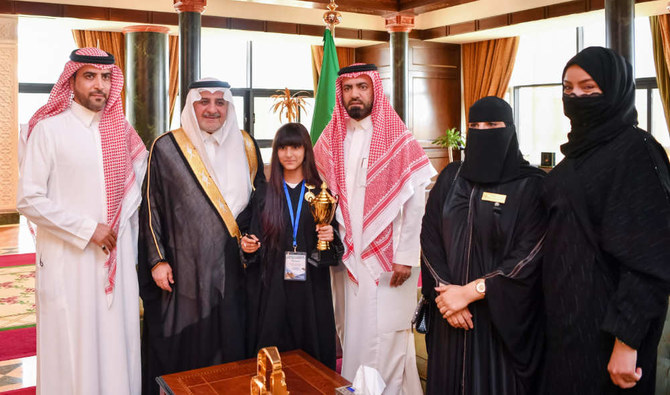
Saudi Student Itizaz Alnefaie breaks World Record. She is honoured by Tabuk Governor Prince Fahad bin Sultan for Top Two Finish in Worldwide Mental Arithmetic Competition, Egypt

Tabuk Gov. Prince Fahd bin Sultan honored Itizaz Alnefaie, the primary school pupil from Tabuk International Schools who won second place in this year’s Worldwide Mental Arithmetic Competition, recently held in Egypt’s Sharm El-Sheikh.

Alnefaie broke the world record by solving 100 maths problems, testing herself against the clock.


He congratulated Alnefaie for this achievement, wishing her more success, noting the Saudi leadership’s support for outstanding students in all scientific fields.


“I’m pleased to meet you and everyone is proud of your achievement,” Prince Fahd said, praising the efforts made by Alnefaie’s parents and teachers, who created the environment for her to reach excellence, and who supported her talent. He also wished her and all of Tabuk’s students future success.

The prince then offered Alnefaie his personal pen as a gift. The head of Tabuk International Schools, Maram Al-Atwi, praised Prince Fahd for the achievement, which comes as a result of his great support for the education sector in Tabuk, noting that this success is an extension of the local and international achievements made by public school students from all Saudi regions.


Hundreds of talented pupils representing more than 25 countries, including Saudi Arabia, participated in this year’s competition.


Solving a math problem might take most people a few minutes. However, Alnefaie takes just a second or two.

source/content: arabnews.com (edited)

___________

Tabuk Gov. Prince Fahd bin Sultan honors Itizaz Alnefaie, the primary school pupil from Tabuk International Schools. (SPA)

_________________

SAUDI ARABIA

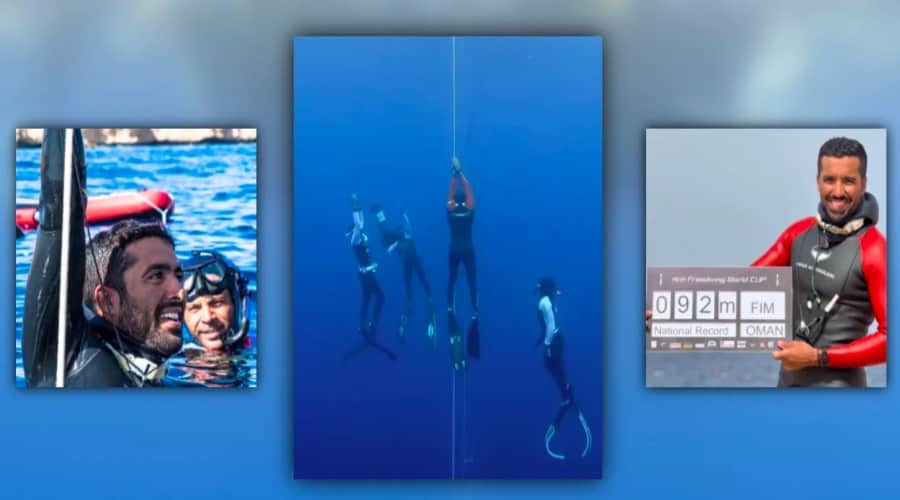
Omani Diver Omar Al Ghailani Sets Record for the 3rd Time ‘Deepest Asian Record in Dual Fins ‘, AIDA Freediving World Cup, Egypt

Omani diver Omar Al Ghailani achieved the deepest Asian record for the third time in the dual fins specialty with a depth of 92m CWTB in the diving championship held in Sharm El Sheikh in Egypt – AIDA Freediving world cup – May.

Omar Al-Ghilani said that he is determined to achieve more national numbers in the coming days, noting that the feeling is different every day in the atmosphere of the tournament.

Al-Ghilani said: Every day I develop a plan and scenario for the next day, but changes occur that can change everything, explaining: Sometimes there are unexpected waves or the water temperature changes, and these are some conditions that can affect concentration and readiness to dive.

Al-Ghilani confirmed that his diving experience made him ready to perform better and enjoyable despite all circumstances, adding: I am still learning and developing myself in this field.

Omani diver Omar Al Ghailani achieved a national record on the second day of the championship, as he managed to dive to 92 meters in free diving.

It is worth noting that the Omani champion Omar Al Ghailani is the world record holder in free diving and has strengthened the position of the Sultanate of Oman in regional and international forums.

source/content: arabiandaily.com (headline edited)

_________

_________

OMAN

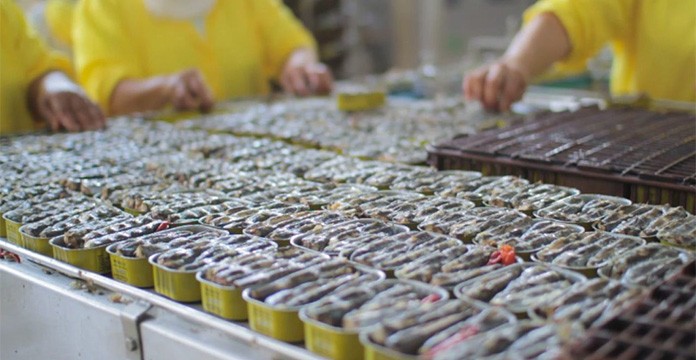
Morocco Produces Half of All Canned Sardines Worldwide

Morocco exports 90% of its sardines to 100 countries.

With a 3,500-kilometer-long coastline, Morocco produces half of all canned sardines available in supermarkets worldwide. 

Mehdi Dhaloomal, Executive Manager of Moroccan canned sardine producer MIDAV, recently reported that the North African country annually produces 1.4 million tonnes of seafood, with sardines making up 850,000 of the collected seafood. 

The Moroccan businessman stressed that Morocco has “exclusive” access to the sardina pilchardus walbaum which is a type of sardine that is only available in Bretagne, France, and southern Morocco. 

Morocco notably fishes 60% of the sardina pilchardus walbaum that is primarily directed to exports – 90% of local sardines are exported. 

Earlier this year, the Moroccan Ministry of Fisheries stated that canned sardines represented 53% of total seafood exports in 2021. 

Besides sardines, frozen octopus and squid, as well as fishmeal, represent most of the 778,000 tonnes of Moroccan exported seafood, valued at MAD 24.2 billion ($2.46 billion). 

Yet canned sardines remain a major food export of Morocco and Dhaloomal considers the country to be a “leader in the valorization” of sardines. 

He further noted that the canned food sector in Morocco consists of roughly 50 Moroccan and international companies that are based along the country’s coastline.

Currently, the industrial zone of Sali delivers 30% of Moroccan production of sardines that is primarily exported to 100 countries. Export destinations include European countries such as the United Kingdom market, where 60% of consumed canned sardines come from Morocco. 

Dhaloomal shared the prior statements at the first edition of the Safi Investor Day. The May 25 event gathered Moroccan and foreign investors operating or interested in the Marrakech-Safi region with the objective of celebrating the region and its assets, as well as attracting additional Moroccan and foreign capital. 

source/content: moroccoworldnews.com

___________

Morocco Produces Half of All Canned Sardines Worldwide

____________

MOROCCO

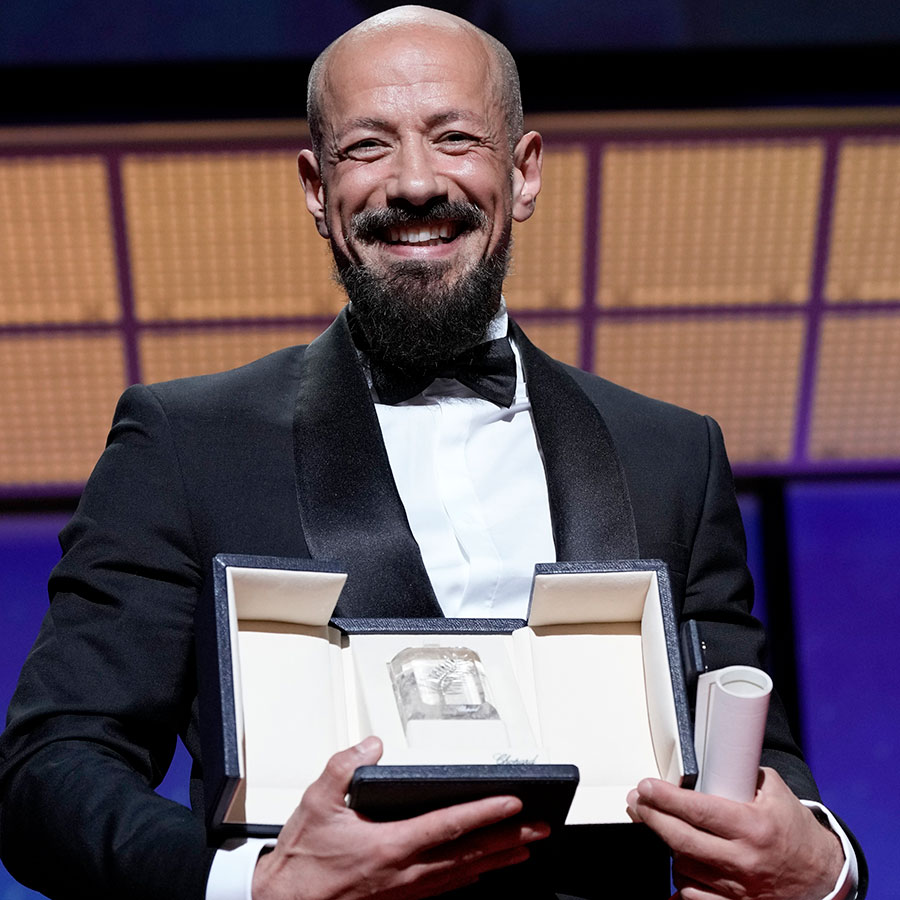
Swedish-Egyptian Tarik Saleh Wins 2022 Cannes’ Best Screenplay Award

Tarik Saleh — an experienced Swedish-Egyptian filmmaker — clinched the Best Screenplay Award at the 75th Cannes Film Festival’s closing ceremony on Saturday for his latest feature film, ‘Boy from Heaven’ (‘Walad Min El-Janna’).

The filmmaker — who started his career as a journalist — also received the Prix François Chalais Award for his film’s  “dedication to the values of life-affirmation.”

Boy from Heaven reportedly caused controversy amid Cannes’ Egyptian attendees after the premier, as its plot — which takes place in Al-Azhar University in Cairo — tackles the relationship between the country’s authorities and the Islamic organisation.

The film is produced by Atmo, Kristina Rikberg, and Fredrik Zander.

Previously, Saleh’s ‘Metropia’ (2009) won the Future Film Festival Digital Award of the Venice Film Festival, and his ‘Nile Hilton Incident’ (2017) — which was also set in Egypt — brought home the Grand Jury Prize from the 2017 edition of the Sundance Film Festival.

The winners of the 75th Cannes Film Festival are as follows:

– Palme d’Or: Ruben Ostlund for ‘Triangle of Sadness’ (Sweden, Germany, France, the UK)

– Grand Prix: Shared by Lukas Dhont for ‘Close’ (Belgium, the Netherlands, France) and Claire Denis for ‘Stars at Noon’ (France)

– Best director: Park Chan-wook for ‘Decision to Leave’ (South Korea)

– Best actress: Zar Amir Ebrahimi for ‘Holy Spider’ (Denmark, Germany, Sweden, France)

– Best actor: Song Kang-ho for ‘Broker’ (South Korea)

– Best screenplay: Tarik Saleh for ‘Boy from Heaven’ (Sweden, France, Finland, Denmark)

– Jury prize: Shared by Jerzy Skolimowski for ‘EO’ (Poland) and Charlotte Vandermeersch and Felix van Groeningen for ‘The Eight Mountains’ (Italy, Belgium, France, Britain)

– Camera d’Or for best first film: Riley Keough and Gina Gammell for ‘War Pony’ (The US)

– Best short film: Jianying Chen for ‘The Water Murmurs’ (China)

source/content: english.ahram.org.eg

________________

Swedish-Egyptian director Tarik Saleh poses during a photocall after he equally won the Best Screenplay prize for the film Boy From Heaven (Walad Min Al Janna) during the closing ceremony of the 75th edition of the Cannes Film Festival in Cannes (Photo: AFP)

___________________________________________

SWEDEN / EGYPT / SWEDISH EGYPTIAN

Souad El Markhous: A Moroccan Success Story in Dutch Construction Sector

Born in Larache in 1969, a young and driven Souad El Markhous found herself in a position where she had to lead a double life in Amsterdam for three years. Her struggle to grow from a young ambitious Moroccan girl to an owner of a Dutch construction company is a story that captures the listener’s heart. 

Determination and perseverance were key in El Markhous’ uncanny journey, and her story reflects the resilience of Moroccan women in the face of social expectations either at home or/and beyond. Still, she conveys an overwhelming sense of gratitude. For her, her story would not have been possible without Allah (God) and rdat walidin (parental blessings).

She left Larache in 1990 to settle down with her cousin in Amsterdam without telling her father. Unfamiliar with the Dutch language and culture, she soon had to look for a job to sustain herself. 

Her neighbor secured a job for her as a cleaner at the construction company De Combi, on the condition of keeping a low profile since the company was only hiring men cleaners.

Boss: from a ‘monster’ to a father-figure

Although she was afraid of getting caught, El Markhous had to clean the director’s office on Wednesday when he had a day off to spend quality time with his family.   

Despite the risk of being exposed, she used to sit in the director’s office and run her fingers through the keyboard, pretending to be working there. 

“I wanted to dream. I wanted to be like them, work,” she told Morocco World News.   

One day her fear came true. The director, Appelman, came to the office on his day off since his children and wife went on a vacation. He entered the office and found her there. They were stunned to see each other. 

From the stories she heard about him, she imagined a well-built and ruthless man who looked more like a “monster.” He met her expectations at first glance, physically at least. Yet he turned out to have a good heart and he became a father figure for her in a foreign country where she barely knew anyone.  

Bucket list check

“What are you doing here?” Appelman asked Souad on that fateful day in his office. Surprised and disoriented, she tried to communicate with him in broken English and French. He quickly ordered his secretary to look for a school for her. She was aged 19 at the time. “You have to learn,” he had said. 

For the following years, she secretly learned the Dutch language at Joke Smit College in Amsterdam (1990-1992) before pursuing an MBA in modern business administration at Schoevers in the University of Amsterdam between 1993 and 1996. 

El Markhous pretended to work overtime to attend school, while Appelman supported her cover story. 

Her father’s words after hearing about her departure and her work as a cleaner were engraved in her heart. Disappointed and sad, her father asked her if he ever mistreated her or starved her to the point that she would clean toilets for Dutch people. 

These words would stay with Souad for much of her formative years in the Dutch capital, motivating her, in a sense, to do her best to make her parents proud. 

Hit by reality and new beginnings

She accepted to have an arranged marriage with the hope of continuing her studies. Her future husband, also of Moroccan-descent, agreed to support her studies. 

Before her departure, Appelman handed her a letter in Dutch addressed to her father. In Larache, she opened and read the letter to her father. The letter, which essentially said that Appelman was her second father in the Netherlands, reassured El Markhous’ father. 

As she returned to the Netherlands, she continued her studies and gradually built up her career with the support of her husband. Now married for 20 years, they have raised two daughters together and established a happy family. 

Over the years, El Markhous rose through the ranks at De Combi, moving from cleaner to telephone operator to the head of administration at the Dutch construction company. She then became a member of the workers’ council, representing her fellow colleagues who all helped her through her journey of settling and integrating into her adoptive country. 

Turning point

In 2014, De Combi was on the edge of bankruptcy. At the time, the construction firm had hundreds of employees and 11 branches across the Netherlands. Four branches closed down and others were sold like in Tilburg and Amsterdam. The buyers made it clear that they would cut jobs.

Feeling responsible for protecting the familial nest she had made for herself at Combi, El Markhous was determined to find a solution to prevent the company from sinking.  And buying a branch was one of the few options available. 

So she decided to buy the Amsterdam branch without hesitation. But then again, not having enough money, she was faced with the impossible feat of making the acquisition within a 24-hour deadline. 

Along with her husband, she started to call friends and acquaintances to collect the money. The workers also contributed with their savings. At the end of the day, she made it and saved the lives of her team members. At the time, De combi workers were unpaid for three months and had to fill in for government support.  

In the following meeting of the workers’ council, she announced her ownership over the Amsterdam branch in front of 600 workers. This made her the first woman to own a construction company in the Netherlands. For the next five years, she managed the company along with the business director Willie van Dijk before establishing Markhous Beheer BV in 2019

Incomplete joy

After she bought De Cambi’s Amsterdam branch, El Markhous’ story gained tremendous public and media interest. Proud of her achievement, she collected all newspaper articles and documents that commended her work and returned home to share her joy with her parents. 

“I hadn’t seen my parents for three years,” she said. Excited to reunite with her family, she entered her home to learn that her father was diagnosed with Al Alzheimer’s. “He couldn’t recognize me,” she told us with teary eyes and a shaking voice. 

Souad’s father passed away in 2016, two years after that visit. Until his last moment, he was unable to recognize his daughter or learn about her success story.

In 2018, El Markhous would be awarded the Ethnic Business Woman among 45 candidates. Months later, she received the Diwan award for her inspiring story and accomplishments.

A year later, she obtained a gift of appreciation and gratitude from the Moroccan embassy in the Netherlands. 

She also featured in the Dutch series “Vrouwen die Bouwen” or “women who build.” Her story was further documented by Cor de Graag in a book titled “Ondernemers zijn net mensen,” which translates into English as “Entrepreneurs are just people.” The book is based on 50 interviews with inspiring entrepreneurs in the Netherlands. 

Committed to helping others

With her growing success, El Markhous has committed to helping other women to achieve their dreams. Despite her busy schedule, she has accepted numerous invitations from NGOs, schools, and other organizations to share her stories but also inspire young women to be brave and pursue their dreams. 

In 2015, she received a call from a young Ethiopian woman living in the Netherlands who wanted to become an engineer. The young woman asked her over the phone to convince her father. 

Later on, the father and daughter visited El Markhous’ office. The father was surprised to see her in the office of a director, particularly that of a construction company.

Souad managed to convince the girl’s father. Three years later, she received a call from the same girl who told her that she now had a job in an engineering company.

The story touched the Moroccan-Dutch entrepreneur, prompting her to commit further to supporting other women as they struggle to establish themselves in male-dominated professions in the construction or STEM sectors. 

Following in the footsteps of Appelman, El Markhous is becoming the guardian angel of numerous girls and women in Morocco and Europe. 

Souad El Markhous’s legacy in the Netherlands and Morocco is in the making as she aspires to invest in her home country. Her dedication, determination, and resilience can be a source of inspiration for every girl and woman around the world. 

source/content: moroccoworldnews.com (edited)

_____________

_________________________________

NETHERLANDS / MOROCCAN

Libyan Author Mohamed Alnaas Wins 2022 Arabic Booker Prize

Bread on Uncle Milad’s Table by Libyan debut novelist Mohamed Alnaas was announced as the winner of the 2022 International Prize for Arabic Fiction (IPAF).

The novel, published by Rashm, was named as this year’s winner by Chair of Judges Shukri Mabkhout during a ceremony in Abu Dhabi that was also streamed online.

In addition to being awarded USD $50,000, funding will be provided for the English translation of Bread on Uncle Milad’s Table, and Mohamed Alnaas can expect to see an increase in book sales and international recognition.

Shukri Mabkhout, Chair of the 2022 Judges, said: “The winning novel is written in the form of confessions of personal experience. Its plethora of details is deftly unified by a gripping narrative, which offers a deep and meticulous critique of prevailing conceptions of masculinity and femininity and the division of work between men and women, and the effect of these on both a psychological and social level.”

He added that the novel, falls into the category of novels which question cultural norms about gender; however, it is embedded in its local Arab context, and steers away from trivial projections or an ideological treatment of the issues, which would be contrary to the relativism of fiction and its ability to present multiple points of view.   

Bread on Uncle Milad’s Table is a unique story based in Libya. In the closed society of his village, Milad strives to live up to the definition of ideal masculinity, as his society views it. However, after all his best efforts, he fails to be ‘a man’, and after meeting his sweetheart and wife-to-be, Zeinab, decides to forget about this definition and be himself. Living at home, he performs the tasks which his society reserves for women, while Zeinab works and supports the family. Milad is unaware of how he is mocked in the village until his nephew breaks it to him. Bread on Uncle Milad’s Table questions static ideas of gender and champions the individual in the face of destructive ideas adopted by the majority. 

Mohamed Alnaas, is a short story writer and journalist from Libya, born in 1991. He obtained a BA in Electrical Engineering from the University of Tripoli in 2014, and his short story collection Blue Blood was published in 2020. Bread on Uncle Milad’s Table (2021) is his first novel and he wrote it in just six months during lockdown and whilst Tripoli was under bombardment. He says writing the book was his “refuge from insanity” amidst the news of Covid and war.

At 34, Alnaas is the second youngest writer to win the International Prize for Arabic Fiction and the first Libyan. Bread on Uncle Milad’s Table was published with support from the Libyan Arete Foundation.

Bread on Uncle Milad’s Table was chosen by the judges as the best work of fiction published in Arabic between 1st July 2020 and 30th June 2021. It was chosen from a shortlist of six novels by authors from Egypt, Kuwait, Libya, Morocco, Oman and, for the first time, the UAE. The shortlisted finalists — Khalid Al-Nassrallah, Tareq Imam, Reem al-Kamali, Bushra Khalfan and Mohsine Loukili — will each receive USD $10,000.

The panel of five judges was chaired by Tunisian novelist, academic and previous IPAF winner (The Italian, 2015) Shukri Mabkhout. Joining him on the judging panel were Libyan doctor, poet and translator Ashur Etwebi, Lebanese writer and PEN International board member Iman Humaydan, Kuwaiti poet and critic Saadiah Mufarreh and Bulgarian academic and translator Baian Rayhanova.

source/content: english.ahram.org.eg

_____________

pix: arabicfiction.org

________

LIBYA

Morocco’s RS Berkane Win 2nd African Confederation Cup Title (CAF) with a Shootout Victory over South Africa’s Orlando Pirates

Moroccan side RS Berkane won their second African Confederation Cup title in three years after beating South Africa’s Orlando Pirates 5-4 on penalties following a 1-1 draw at Nigeria’s Godswill Akpabio Stadium on Friday 20th May.

Brahim El Bahraoui scored the winning penalty after Pirates keeper Richard Ofori, who had scored his side’s fourth spot kick, failed to save any of Berkane’s efforts.

Winger Thembinkosi Lorch turned from hero to zero as Pirates missed out on their maiden Confederation Cup triumph after also losing in the 2015 final.

He scored a bizarre 117th-minute equaliser to cancel out Youssef El Fahli’s penalty in the first half of extra time but had his effort blocked by keeper Hamza Hamiani in the shootout.

Hamiani was Berkane’s standout performer, producing some superb saves to keep his side in the game as Pirates looked the better side throughout.

Berkane lost on penalties to Egypt’s Zamalek in the 2019 final but won the trophy a year later. Another Moroccan side, Raja Casablanca, clinched the title last year.

Key saves

Hamiani kept out a low, angled effort from striker Kwame Peprah on 34 minutes before producing an even better save to smother a close-range effort from Deon Kavendji early in the second half, denying Orlando a certain goal.

He also comfortably collected a tame shot from Lorch, who was well-positioned to score following some slack defending.

Berkane, who rarely threatened, took the lead in the 97th minute when Pirates substitute Thabang Monare, who had just been on the pitch for a few minutes, clumsily stuck out a leg to foul an opponent following a corner.

El Fahli sent keeper Ofori the wrong way with a low effort as Berkane thought they had the match dead and buried.

But Pirates did not give up, with Tshegofatso Mabasa heading just wide from a corner before Lorch brought them level three minutes from the end of extra time.

After his initial effort was blocked by the defence, Mabasa collected the loose ball just inside the area and sent a stray pass that somehow eluded all defenders and found its way into the bottom corner past Hamiani, who had been unsighted by his own defence.

But Berkane had the last laugh in the shootout, converting all of their kicks, as Moroccan teams made it a hat-trick of straight Confederation Cup triumphs.

source/content: english.ahram.org.eg

_____________

Morocco s RS Berkane beat Orlando Pirates in the African Confederation Cup final on Friday (Photo: Pirates official Twitter account)

_____________

MOROCCO

Winners of 2022 Sheikh Zayed Book Award (SZBA)

The award saw a high turnout from authors around the world, with more than 3,000 applications submitted from more than 55 countries, including 20 Arab countries.

Sheikh Zayed Book Award (SZBA) announced on Monday the winners for its 16th edition across seven categories, selecting six literary figures, intellectuals and translators, along with Egypt’s Bibliotheca Alexandrina, for top honours.

Over the years, the Sheikh Zayed Book Award has managed to expand and become one of the most prestigious events in the Arab world, allowing for the development of cultural dialogue and the creation of new opportunities for authors and translators around the world.

This year’s winner in the young author category is Tunisian professor Mohamed al-Maztouri with his book Al Badawa fi al She’er al Arabi al Qadeem (Bedouinism in Ancient Arabic Poetry).

“The author of this book, Mohamed al-Maztouri, presents a serious academic study of bedouinism in ancient Arabic poetry,” the Zayed programme commented.

Adding that Maztouri “discusses its diverse concepts and many manifestations, describing it as a culture with special landmarks and a lifestyle inseparable from its place, environment, and geography.”

From pre-Islamic times the Arabian Peninsula has been home to world-class poetry that is deeply connected to values of bravery, nobility, eloquence and at times sensitivity.

Throughout the centuries, poetry’s popularity has only grown in the region, attracting new audiences in both the Arabian Peninsula and other Arab countries in North Africa and the Levant.

Today, the trend has been further boosted by Emirati initiatives and competitions.

The translation award went to Egyptian translator and author Ahmed Aladawi for his translation of the American author, George Makdisi, book “ The Rise of Humanism in Classical Islam and the Christian West” into Arabic.

Each winner receives a life-changing prize of AED 750,000 (USD 204,190/GBP165,220).

Winners will also be honoured in a ceremony at the Abu Dhabi International Book Fair later this year.

The Cultural Personality of the Year winner will be presented with a gold medal and a certificate of merit, as well as a Dh1 million prize.

source/content: thearabweekly.com

______________________

Full list of winners of the Sheikh Zayed Book Award 2022:

Literature

Maq’ha Riche, Ain Ala Massr (Eye on Egypt: Cafe Riche) by Maisoon Saqer. Published by Nahdet Misr Publishing

Children’s Literature

Loghz al Kora al Zujajiya (The Mystery of the Glass Ball) by Maria Daadoush. Published by Dar Al-Saqi

Young Author

Al Badawa fi al She’er al Arabi al Qadeem (Bedouinism in Ancient Arabic Poetry) by Mohamed Al-Maztouri. Issued by the Faculty of Literature, Arts and Humanities at Manouba University and the GLD Foundation

Translation

Nash’at al Insaniyat Einda al Muslimeen wa fi al Gharb al Maseehi (The Rise of Humanism in Classical Islam and the Christian West) by Ahmed Aladawi. Published by Madarat for Research and Publishing.

Art and Literary Criticism

Al Sarid wa Taw’am al Rooh: Min al Tamtheel ila al Istinaa (The Narrator and the Soulmate: From Acting to Faking) by Mohamed Aldahi. Issued by Le Centre Culturel du Livre.

Arab Culture in Other Languages

The Arabian Nights in Contemporary World Cultures: Global Commodification, Translation, and the Culture Industry by Muhsin J. Al-Musawi. Cambridge University Press.

Publishing and Technology

Bibliotheca Alexandrina

source/content: thenationalnews.com

__________

______________________________________________

EGYPT / MOROCCO / SYRIA /TUNISIA / U.A.E.

 UAE : Federal Supreme Council elects Mohamed bin Zayed as UAE President: May 14th, 2022

The Federal Supreme Council today unanimously elected His Highness Sheikh Mohamed bin Zayed Al Nahyan as President of the United Arab Emirates.

The Council held a meeting today at Al Mushrif Palace in Abu Dhabi, chaired by Huis Highness Sheikh Mohammed bin Rashid Al Maktoum , Vice President, Prime Minister and Ruler of Dubai.

The meeting was attended by His Highness Sheikh Mohamed bin Zayed Al Nahyan; H.H. Dr. Sheikh Sultan bin Muhammad Al Qasimi, Supreme Council Member and Ruler of Sharjah; H.H. Sheikh Humaid bin Rashid Al Nuaimi, Supreme Council Member and Ruler of Ajman; H.H. Sheikh Hamad bin Mohammed Al Sharqi, Supreme Council Member and Ruler of Fujairah; H.H. Sheikh Saud bin Rashid Al Mu’alla, Supreme Council Member and Ruler of Umm Al Qaiwain; and H.H. Sheikh Saud bin Saqr Al Qasimi, Supreme Council Member and Ruler of Ras Al Khaimah.

A statement issued by the Ministry of Presidential Affairs said that according to Article 51 of the Constitution, His Highness Sheikh Mohamed bin Zayed Al Nahyan was unanimously elected as the President of the UAE to succeed the late Sheikh Khalifa bin Zayed Al Nahyan .

Their Highnesses, the Supreme Council Members and Rulers of the Emirates have reaffirmed their keenness to continue implementing the authentic values and principles laid down by the late deceased, Sheikh Khalifa, following on from the founding father, the late Sheikh Zayed bin Sultan Al Nahyan. These have consolidated the UAE’s status at both regional and global levels.

The Federal Supreme Council expressed its full confidence that the people of the UAE will remain, as Sheikh Zayed and the founders believed, “a faithful guardian of the Union and its gains at all levels”.

Their Highnesses wished H.H. Sheikh Mohamed bin Zayed Al Nahyan success in serving his people and country.

Sheikh Mohamed bin Zayed expressed his appreciation for the precious trust placed in him by his brothers, Their Highnesses the Supreme Council Members and Rulers of the Emirates, praying to the Almighty to guide and help him to bear the responsibility of this great trust and to fulfil its tasks of serving his country and people.

source/content: wam.ae

_________

________________________________________________

ABU DHABI, UNITED ARAB EMIRATES (U.A.E.)