Presented at the Les Rencontres de la photographie d’Arles – a summer photography festival in France – that runs between 6 July and 4 October, French-Algerian photographer Bruno Boudjelal showcases his body of work Goudron, Tanger–Le Cap, a hazy journey across the African continent from north to south.
The exhibition Goudron, Tanger–Le Cap brings together the body of work from the photographer’s travels across the African continent for over 20 years.
Photographs and Super 8 analogue films accompany the publication of a photography book by EXB, allowing readers to delve into around 15 stories of people Boudjelal encountered along the way.
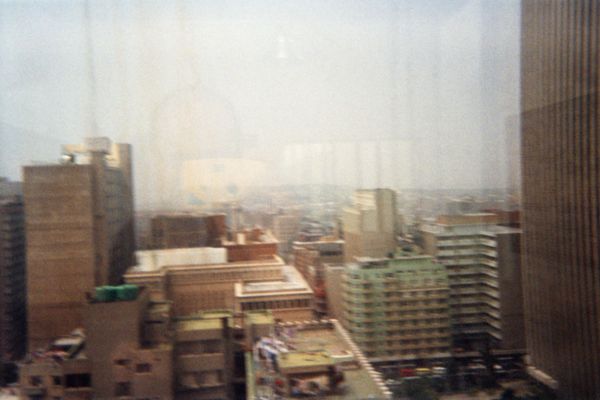
The photographs are conceived as hazy, fleeting wanderings through landscapes and cities where human figures occasionally emerge. The viewer’s eye searches for an impossible point of focus, as though doubt and questions have replaced certainty and answers.
“After this long journey, it seems to me that all these obstacles to the movement of people and goods are a real factor in underdevelopment. It is this invisible border that I address in my work, this barrier that blocks you at every step,” the exhibition notes state.
Boudjelal did not initially intend to become a photographer, let alone to photograph Algeria. Formerly a guide in South Asia, he was advised to take photographs. For someone who had not even realized he was Algerian, the search for his roots in Algeria during the civil war subsequently became an important part of his work.
His distinctive visual style took shape after the viewfinder of his camera was stolen in Algiers. During a visit to McDonald’s, a young girl lent him a disposable camera she had won with a children’s meal. He continued photographing in Algeria with the camera for 10 years.
“I didn’t know how to work any other way than with the McDonald’s,” he admits. His photography became one of movement, with landscapes and people crystallizing in the colourful blur that would define his visual signature.
He was then advised to photograph without a viewfinder and without framing his shots — the starting point for what he calls “non-photography.” Faced with the impossibility of stopping, framing, and pressing the shutter, he explains: “You always have to give the impression that you’re going somewhere; you can’t wander aimlessly.”
He adds: “This non-practice of photography, or rather this particular practice, comes from my confrontation with Algeria during the dark years.”
In 2003, he presented ten years of work in Algeria at Arles, bringing that chapter to a close.
Former Libération journalist Florence Aubenas then encouraged him to return to the African continent. He joined the “Ports of Africa” project, with Gabon as the first stop on his journey. Libération hired him for nine months to cross the continent — an unusual contract that was largely unknown among photographers of his generation and astonishes young photographers today.
Between autumn 2004 and autumn 2005, he completed the journey in one continuous trip. A subsequent split within the newspaper reshaped its editorial team, and the new team was unaware of the completed journey.
Ten years later, in 2025, nine images from the project were published as part of the book 50 Years in the Eye of Libé. “As I was about to cross Africa, I thought I would change my way of photographing, that my photography would evolve. I was wrong. That doesn’t mean it’s impossible, but when you pass through the major capitals, they remain very difficult to photograph,” he says.
Placing visitors in the middle of the stories
For Boudjelal, the photographic act goes hand in hand with a natural curiosity about the stories of the people he encounters. “I want to place visitors in the flow of these individual stories,” he says.
The roughly 100 stories he collected over the years remain largely undisclosed. The question remains open for him: what will he do with all the stories that were not included in the book?
In 2003, while exhibiting at the Rencontres de Bamako, he encountered talibé children in the park surrounding the museum hosting the exhibition. These children, found across Francophone West Africa, are officially entrusted by their families to imams to receive religious education. Unofficially, however, they are often required to collect money for the imams through begging.
Boudjelal met Yousou, one of these children, who was originally from Gambia. His father and later his uncle had entrusted him to imams. The imam exchanged him and his friends for other children in Bamako. A year and a half later, the paths of the two friends crossed again by chance at Dakar’s bus station. The child told him that the imam had exchanged him again in Dakar for other children.
“We travelled by train without tickets. It was the best moment of my life; I had never felt so free,” he told Boudjelal, then aged 11. Living on the streets had become an escape from the imam, who had “tortured” them, in his words.
An African photography scene yet to be discovered
For the past 20 years, Boudjelal has returned to the continent to conduct workshops with French cultural institutes and other institutions, including fine arts schools in Kinshasa and N’Djamena. Through these workshops, he has trained young local photographers.
For some, the workshops became stepping stones, including a young photographer from Lagos whose work was later exhibited at MoMA. Boudjelal stresses the importance of being present and receptive to the hidden talent of local photographers. He points to the lack of funding, connections, and openness that continues to prevent many of these young photographers from gaining wider exposure.
Geopolitical challenges also hinder the circulation of this talent, including the situation in Mali, which is increasingly affecting the Rencontres de Bamako photography festival.
“Whether you go to Egypt, Chad, Burkina Faso or Ghana, you find people who have just as much talent and different forms of expression,” he says. “All you have to do is give them your attention and talk about their work.”
_____
This article was originally published in Al-Ahram Hebdo (French) on 12 August 2026. Additional editing and translation: Ahram Online
source/content: english.ahram.org.eg (headline edited)
_____________
________________________
FRENCH / ALGERIAN