MOROCCAN: Sara Chraibi, Founder of Maison Sara Chraibi Discusses Her Haute Couture Designs

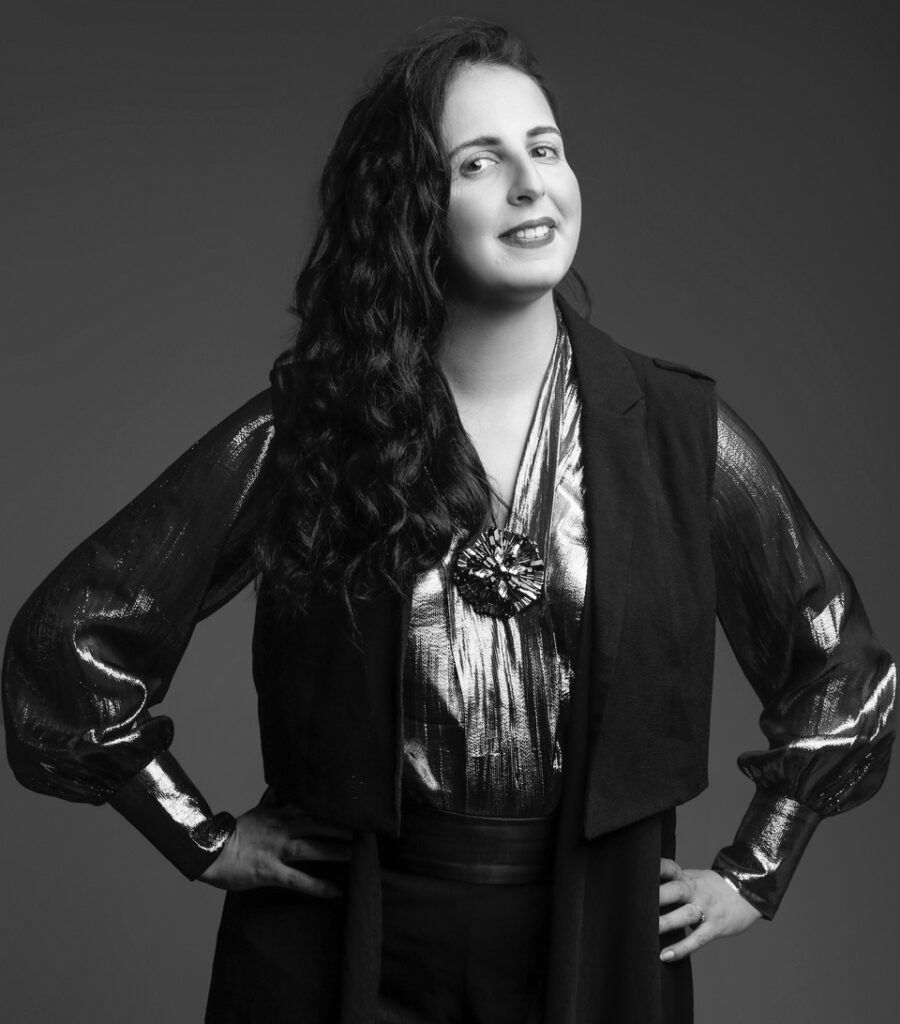
This January, Sara Chraibi, founder of Maison Sara Chraibi presented for the first time at Paris Haute Couture Week. The Moroccan designer greatly impressed critics with her collection which combines traditional Moroccan craftsmanship with modern elements and materials for a unique style that celebrates her heritage but also appeals to the contemporary woman.

After living in Paris and working as an architect for several years, Chraibi returned to her home country to establish her fashion brand. It was a major shift in cultures but she wanted to be in her homeland in order to find ways to embrace the traditional craftsmanship techniques and find new ways to express this as a form of contemporary luxury. Her designs are deeply rooted in traditions but also appeal to the wider world. This season Chraibi presented her Spring/Summer 2023 collection at Paris Fashion Week after being invited by the Fédération de la Haute Couture et de la Mode to showcase her designs to the world. Here we find out more about the experience and what we can expect to see from her brand moving forward.

Tell us a little about how your brand came to life.

I grew up in an environment of art and culture. As a child, I was introduced to sewing and embroidery by my mother. After my architectural studies in Rabat, I moved to Paris where I wrote a diploma (DEA) in “Philosophy and Theory of Architecture”. In Paris, my passion for fashion and couture is nourished by the vitality and ​​creativity of the city. Alongside my job as an architect, I then began to draw, sew and embroider a multitude of couture pieces.

In 2012, I presented my first collection “Anatomic Architecture” during the final of a Competition organized by “Ateliers de Paris”. In the same year, I participated in Festimode Casablanca Fashion Week where the models paraded in front of the Casablanca cathedral. Greeted unanimously by the public and the press, these first appearances were the beginning of my professional retraining.

Congratulations on the Spring/Summer 2023 collection – tell us about this collection and how it came to life. 

When I started working on this collection, I wanted to share several elements of my personal story, my influences and my sensitivity to the world. I had this idea of ​​weaving a collection where each thread would represent part of the story: beginning with the architecture, the relationship to the structure of the garment, then there is the know-how, coming from a Moroccan textile tradition and the memory of the elegance of Moroccan women, there is this double culture that makes the originality of my point of view on fashion. I wanted to weave all this together and make it into a framework to tell a new reality.

This was your first time showing at such a level tell us about your experience being a guest member of the FMHC. 

For me, Haute couture is a dream, a celebration of uniqueness and being part of it as a guest member is a milestone for my brand.

Can you tell us about some of the traditional techniques that you used in your designs and how you have evolved the techniques and craftsmanship to give them a modern twist?

With my work, I take patterns, shapes and ancient techniques from Morocco but I add a certain twist or reinvent them in a new way. For example, I used the “sfifa” weaving technique to create a fabric rather than using it as an ornament, as is done traditionally. I mixed raw materials from Morocco, and I used golden thread and silk fringe to build garments as a link between two cultures and realities. I see traditional craftsmanship both as an inspiration and a call to innovation.

How do your heritage and upbringing influence your work today?

My brand is built around the Moroccan art of living, my architectural background and my interest in couture know-how inspire it. My brand aesthetic evolves around the idea of subdued femininity. With a timeless approach to eveningwear, I merge the East and West through one-of-a-kind couture garments.

Tell us about your first memory of fashion. 

I remember times before my mother had an important party, we would stroll from stall to stall in the markets in search of fabric and she would make dresses from scratch. I would sit next to her and watch her assemble the pieces of fabric one by one and sculpt the garment. At that time I started to collect fabric scraps to in turn sew something for my barbie doll. There was something magical about those moments. As I grew up, I remember my impatience to get dressed for these events; to put on a beautiful dress, to finally be part of the adult world, with all those sophisticated ladies, perfumed, richly adorned in silk and lace, with an appearance that made everyone’s heads turn. The women of Morocco are beautiful and sensual and wearing a caftan is an ancestral tradition, a ritual that is passed down from mother to daughter.

How do you think your background in architecture has influenced your designs and the way you put looks together?

I quickly realised that fashion and architecture could share the same vision. As an architect, I liked the modern period. In my clothing designs, I am influenced by modern architecture. All my attention goes to the purity of the lines, to the elegance and the lightness of the structure, it is a sort of quest for the essential.

What is the vision for your brand moving forward?

For me, succeeding in the world of fashion comprises several essential elements: commercial success, of course, but also and above all, success together as a team to share values ​​and wealth, to ensure that each person in the company grows through their work. There is also a cultural success, where in addition to offering products, a brand manages to permanently establish its universe in the collective imagination. That’s all I want to achieve for my brand.

Who are some of the designers or brands that you admire?

Madeleine Vionnet, Jeanne Lanvin, and Elsa Schiaparelli, all made contemporary fashion history with a feminine point of view. I also admired Lee McQueen’s vision and Azzedine Alaia’s sharpness.

There are few brands from the Arab region that have managed to reach success on a global level – what is your opinion on this and what advice would you give to aspiring designers in the Middle East?

I wish that there are more and more brands with an Arab or oriental DNA on the international scene. Fashion is a great tool of soft power. Each new designer who launches in the region is responsible for spreading our culture to the rest of the world.

In this issue we are celebrating the month of Ramadan, what does this time mean to you and how will you be spending it this year?

Ramadan is one of my favourite times of the year. It’s time to reconnect with our faith. I like to spend it with my family and friends, to celebrate with pride and joy and I also like to share iftar with my non-Muslim friends.

What is next for you this year and for the rest of the year?

I’m working on the Maison Sara Chraibi Fall/Winter 2023 couture collection. I will also launch an e-commerce site later in the year.

What can you tell us about your brand in the Middle East and can we expect to see you here soon?

I plan to do some trunk shows in the Middle East over the coming months. The Middle East is an important market for my brand and It’s very important to establish long-term commercial partnerships there.

source/content: aeworld.com (headline edited) / Lindsay Judge

___________
____________

MOROCCO
SAUDI ARABIA: 25,000 Artifact Fragments from early Islamic Period Unearthed from Historic Jeddah 

As many as 25,000 fragments of artifacts dating back the Islamic caliphates during the first two centuries of the Hijri Calendar, corresponding to the 7th to 8th centuries AD, have been discovered from the Jeddah Historic Area.

The announcement in this regard was made by the Jeddah Historic District Program (JHDP), in collaboration with the Saudi Heritage Commission. The archaeological discoveries were announced as part of the Historic Jeddah Revival Project, initiated by Crown Prince and Prime Minister Mohammed bin Salman..

According to a press release from the JHDP, the project of excavation started in January 2020 with exploratory studies and a geophysical survey. The goal was to unveil the historical significance of four key locations: Othman bin Affan Mosque, Al-Shona, a segment of the Northern Wall, and Al-Kidwah. This archaeological endeavor falls within the purview of the Jeddah Historic District Program. The project aims to preserve national antiquities and archaeological sites, uncover the rich history of the Kingdom, and promote Historic Jeddah as a cultural and tourist destination, in line with the Saudi Vision 2030.

According to the release, in November 2020, the archaeological survey and excavations yielded significant findings, including 11,405 pottery shards weighing 293 kg, 11,360 animal bones weighing 107 kg, 1,730 shells weighing 32 kg, 685 building materials weighing 87 kg, 187 glass artifacts weighing 5 kg, and 71 metal artifacts weighing 7 kg. The combined weight of these archaeological findings is 531 kg; and they constitute a valuable contribution to Saudi Arabia’s archaeological discoveries.

Archaeological investigation at Othman bin Affan Mosque revealed artifacts dating back the first two centuries AH and spanning different historical periods, notably, ebony pillars found near the Mihrab, analyzed and traced back to Ceylon (now Sri Lanka) Island in the Indian Ocean, which highlight the extensive trade connections of historic Jeddah.

According to the release, excavations at the same site also unveiled a collection of ceramic vessels and fragments, including high-quality porcelain. Some of the pieces are made in the Chinese province of Jiangxi and date back to the 16th-19th centuries AD, while older pottery fragments are from the Abbasid era.

The archaeological site at Al-Shona, dating back at least to the 19th century AD, has yielded numerous pottery shards, including porcelain and ceramic from Europe, Japan, and China, dating from the 19th to 20th centuries. Excavations at Al-Kidwah (Bab Makkah – Makkah gate) revealed parts of the Eastern Moat, which most likely date back to the late 18th century.

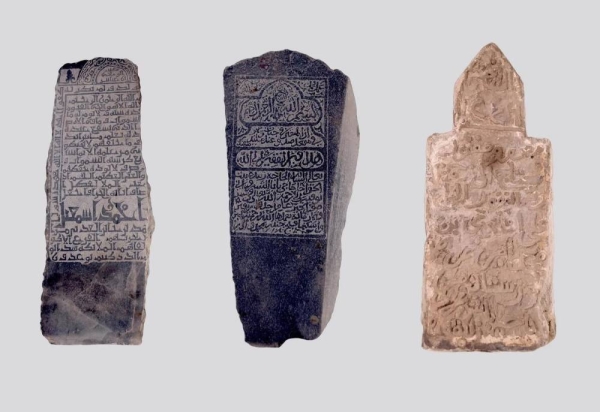
Tombstones made of Mangabi stone, marble, and granite were found at different locations within historic Jeddah. These tombstones contain inscriptions of names, epitaphs, and Qur’anic verses, dating back possibly to the 2nd and 3rd centuries AH. Specialists are currently studying them carefully.

The archaeological studies at the four historical sites involved excavations, radiocarbon analysis, soil analyses, geophysical surveys and scientific examination of artifacts. Samples of wood from 52 buildings were sent to international laboratories for identification and dating. Moreover, extensive international archival research led to the collection of over 984 historical documents, including maps and drawings of historic Jeddah. They are currently undergoing detailed study.

The Jeddah Historic District Program and the Heritage Commission collaborated to oversee the documentation, registration and preservation of archaeological artifacts found in Historic Jeddah. These discoveries were listed in the National Archaeological Register, and scientific databases were created to preserve the information related to the discovered artifacts.

source/content: saudigazette.com.sa (headline edited)

________________

The archaeological discoveries were announced as a part of the Historic Jeddah Revival Project, initiated by the Crown Prince and Prime Minister Mohammed bin Salman

_________________

SAUDI ARABIA

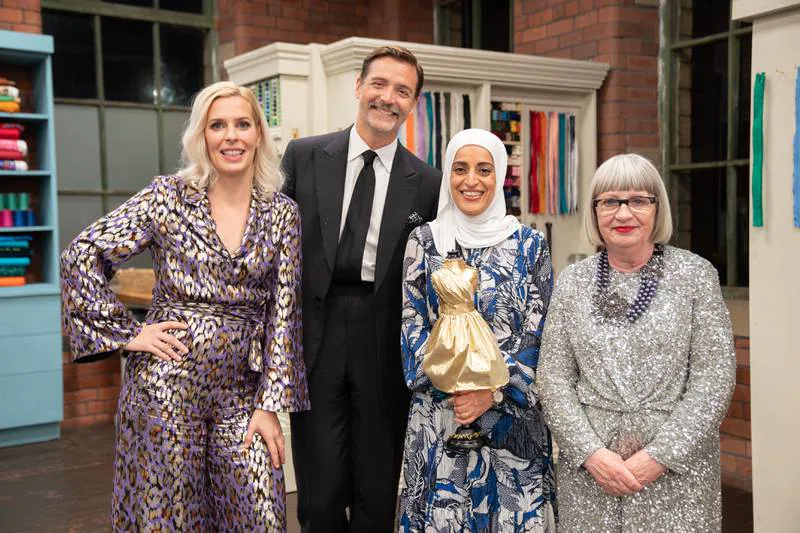
IRAQ- U.K: Sewing Queen and Surgeon Dr. Asmaa Al-Allak’s memories of Iraq are woven into her very fabric

Handed-down skills won the medic crown of Great British Sewing Bee champion.

Head bent in concentration, tape measure slung around her neck, young Asmaa Al-Allak often knelt on the floor amid piles of colourful fabric even as rockets whistled above the family home in southern Iraq.

The seven-year-old would take in every detail of her mother and grandmother flicking through pages of their favourite fashion magazine and discussing the sewing patterns for each outfit featured in that month’s issue.

While the two women traced templates on to bolts of material, Asmaa mimicked them in miniature on remnants for arguably the best-dressed Sindy doll in war-torn Basra.

Four decades later, childhood memories like these compelled Al-Allak to become a contestant on The Great British Sewing Bee 2023, a reality TV show she won in an achievement that, for her, topped even attaining a medical degree.

“Creativity is in the genes,” she tells The National, laughing over a zoom call from Wales, where the consultant breast surgeon, now 47, lives with her engineer husband and children, Sophia, 20, and Jacob, eight.

“My grandmother taught me the basics of sewing, my mother built on those and the rest is self-taught.

“The first thing I remember making for myself was a green cotton pinny dress with a floral design. Terrible! My gran was the only one who was positive, saying: ‘My God, that’s so amazing.’ But that’s grandmothers for you.”

Mariam Al-Ethan didn’t live to see her granddaughter’s greatest triumph but photographs of her were pinned to a vision board for inspiration throughout the competition, and Al-Allak proudly wore a necklace inscribed with the word “Allah” that her grandmother bought for her in a gold souq.

Married at the age of 12, Mariam had long sewed clothes for her extended family before becoming a professional seamstress out of necessity during the prolonged armed conflict between Iran and Iraq in the 1980s.

“It was a really difficult time. Even though my grandad worked, he didn’t have enough to support the family,” says Al-Allak.

In spite, or perhaps because, of being illiterate, Mariam made determined efforts to send her seven children, including Asmaa’s mother Fatima, to university.

Fatima studied at the University of Basrah before undertaking a doctorate in physics at Cardiff University with her husband, Haider, soon after baby Asmaa arrived in 1976.

Initially, Asmaa and her brother Ammar, born two years later, were raised by their maternal grandmother but joined their parents for a few years when Fatima sent for them shortly before hostilities broke out. No longer able to stay in the UK after finishing her PhD, however, Fatima returned with the children to Iraq.

Haider feared his name might be included on the Baathist regime’s list of traitors and objectors and a longed-for reunion would not occur for another eight years.

The Al-Allak siblings were plunged into a war zone, frequently changing schools as they moved between Basra and their father’s relatives near Baghdad, whichever was deemed safest as Iranian troops fired mortars across the border.

When classes were disrupted for up to three months at a time, Asmaa sat transfixed for hours watching broadcasts of the devastation.

“I’ve seen [images of] dead bodies lying in the road,” she says in a flat voice. “If the Iraqi army had a good advancement or had won a battle, they would show pictures from the front on television.

“Even though they were supposed to be the enemy, for me, they were people who had died. My decision to study medicine came because of what I’d seen in Iraq.”

She became an expert in gauging the threat from rocket fire. If a whistle could be heard overhead, Al-Allak knew it was probably going to travel farther.

The ones that didn’t whistle were the more dangerous “because you didn’t know where they would land”.

Backbone of the family

While her mother worked as an assistant professor at the University of Basrah, Al-Allak inevitably grew close to her grandmother, ever the backbone of the family.

The detached house was surrounded on three sides by other homes, and Mariam declared the small kitchen, tucked away at the rear, to be the safest of all the rooms. There, the extended family retreated during the worst bombing campaigns, lying “like sardines” on two mattresses squeezed between the oven and fridge.

For Al-Allak, the rules and rhythms of sewing became a comforting reliability in a world of chaos and confusion: if she followed a pattern, cut fabric on the bias, respected the grain line and measured correctly, a satisfying outcome was guaranteed.

“The only thing that’s kept me going and balanced in life – especially in the past few years – has been sewing.

“It’s my escape, my way to forget about all the troubles in the world and at work. I don’t think I will ever stop.”

An opportunity arose for Al-Allak to rejoin her father after the Gulf War ended in 1991 when Haider was a British citizen working as a physics researcher at Durham University.

Fatima and the children had already endured one failed attempt to leave after Saddam Hussein invaded Kuwait the year before, packing their bags and waiting in Baghdad for two days before realising all flights had been cancelled.

This time, at Mariam’s behest, she wasn’t taking any chances. “We left everything behind and walked away. There was still food in the fridge and toys on the floor.”

Ripped from her roots

If Al-Allak was devastated at being ripped from her roots, worse came on hearing of the impact the sudden separation had on her grandmother, who sat weeping surrounded by their abandoned possessions.

“It broke her heart,” she says.

After a gruelling 24-hour bus journey to Jordan, the family waited a month for visas to Britain, arriving in the north-east of England in August.

Young Asmaa had forgotten most of the words picked up during her three-year stay as a toddler, and the other pupils at Framwellgate School showed no mercy, mocking her poor grasp of the language, using racist taunts, and pulling her hijab off.

She was pushed to breaking point, and it is clear that the recollections are still painful.

“I couldn’t wait to leave. I used to go home and cry. I said to my Mum: ‘I’m not going back to school. I just can’t do it any more.’”

But Al-Allak, one in a line of strong women, developed a methodical and meticulous means of getting by. “My five-year goals keep me going through life,” she says.

“For me to become a doctor, I knew I had to get good grades. I had to cope with the surrounding environment and not let it affect me.

“My mother was a rock. She told me to rise above it and sat with me with a dictionary trying to help but English wasn’t her first language either.”

Sheer determination earned Al-Allak a place at Cardiff University to study medicine, where for the first time in her teenage years she felt a sense of belonging.

Though she had seemingly left sewing behind in the ancestral home together with her beloved Sindy doll, her mother carried on, making surgical scrubs and other outfits for her on a Singer sewing machine bought at a car boot sale.

That old Singer has since been usurped by a newer model but still sits in Al-Allak’s office near the desk where lace and fancy packaging for the bespoke mastectomy bras she creates for her patients can be glimpsed. There, too, is the Sewing Bee award, and, on a mannequin, the dress described by the show’s judges as “spellbinding”, and “a feat of genius” and “clever engineering”.

Modelled in the final by her close friend and fellow doctor Pritti Aggarwal, it unfurled in a mesmerising transition from electric blue shift dress into shimmering emerald gown.

Al-Allak’s skill at overcoming obstacles such as this last of the 10 weeks of tough sewing challenges will, she hopes, increasingly be put to use to help breast-cancer patients recover physically and mentally, unencumbered by uncomfortable bras or incorrectly positioned inserts for prosthetics.

She plans to continue campaigning for greater consistency in patient provision, while developing the mastectomy lingerie into a viable venture.

“It’s one of the things I’m really passionate about,” she says. “On the NHS, you get a prosthetic to fit in your bra for free. Sometimes the company will also offer a free bra but not always, and the pocket might be on the wrong side.

“You’ll have darker-skinned women receiving a light-coloured prosthetic because there is no other option. Patients are offered different things in different parts of Wales.”

Al-Allak talks of how she employs the same knots during suturing in surgical procedures as those used in sewing but isn’t sure whether the medical skills inform her craft or vice versa; she is inclined to think probably both.

Certainly, her love of fashion dictates the choice of “work” shoes that add several inches to her 5ft 2in frame – red-soled patent leather stilettos only swapped for pink Crocs covered in butterflies in the operating theatre.

“Because I make all my clothes, my one guilty pleasure is Louboutins ,” she admits. “I bought my first pair when I became a consultant and I only buy one pair a year.”

That taste for the finer things in life earned Al-Allak the title of “Queen Asmaa” on The Great British Sewing Bee.

Alas, Sophia, heir-apparent, has yet to take up needle and thread in any way that her mother might describe, in her strong Welsh lilt, as “proper serious” but has found an outlet for her imagination as a fine arts student.

“I think it will happen at some point,” Al-Allak says, hopefully.

Meanwhile, the two have bonded over a shared love of musicals, such as Phantom of the Opera, Wickedand Hamilton, and have been to Take That and My Chemical Romance concerts together.

Young Jacob, however, expressed an interest in sewing at seven years old, the same age his mother started, and he helps with cutting, pinning and basic stitching.

“Look what he made!” Al-Allak says, gleefully waving a pattern weight stuffed with rice.

And so the rich seam of familial creativity runs on.

source/content: thenationalnews.com (headline edited)

__________


Asmaa Al-Allak says winning The Great British Sewing Bee topped gaining a medical degree. Photo: BBC

_____________________________

UNITED KINGDOM / IRAQ

QATAR : Doha’s Umm Al Seneem Park Opens the World’s Largest Air-Conditioned Jogging Tracks

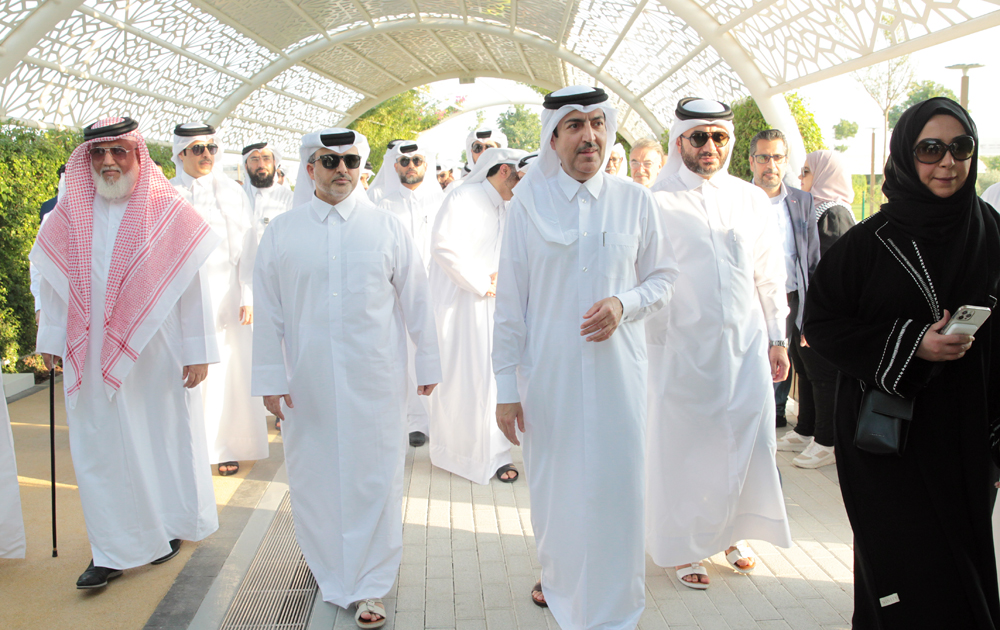
Minister of Municipality H E Dr. Abdullah bin Abdulaziz bin Turki Al Subaie yesterday inaugurated Umm Al Seneem Park, with the largest air-conditioned jogging tracks in the world,  in  Umm Al Seneem, Al Rayan Municipality, breaking Guinness World Records.

The 1,143-metre-long air-conditioned jogging tracks received the title of Guinness World Records for the ‘longest air-conditioned outdoor path’ on October 17, 2022.

The jogging tracks, ensuring temperatures about 26 degree Celsius aim at encouraging visitors for exercise in a bid to make them fit and healthy. 

Speaking to the media, Minister of Municipality said that Umm Al Seneem Park spreads over an area over 130,000sqm is part of an initiative of the Ministry to improve the quality of life by increasing green spaces in Qatar.

“We have increased the green spaces in the country over 10 times, compared to those in 2010 by building parks, landscaping and green areas,” said the Minister.  He said that public parks are equipped with fitness machines, children play areas and joggers trackers, including some of them air-conditioned for the comport of visitors.

“The parks have been built following sustainability goals to cut the carbon footprint and provide fresh air to visitors,” said the Minister, adding that the efforts will continue to open more new parks in near future. 

Speaking to The Peninsula, Director of Public Parks Department, Muhammad Ali Al Khouri said that the jogging tracks of Umm Al Seneem Park has been registered in the Guinness World Records and an official certificate for the title of the record was issued by the officials about a week ago. 

The Umm Al Seneem Park was developed by the Public Works Authority (Ahghal) in coordination with the Ministry of Municipality.

The park, stretching over an area of 130,105sqm, can accommodate about 6,000 visitors per day. The green spaces of the park covers 68 percent of total areas, 88,400sqm dotted with 912 trees of 18 types, including 75 local trees and 820sqm long green walls. The park includes many important facilities, including the outdoor air-conditioned jogging-track for running and walking with a length of 1,143 metres, which is in a circular shape around the park.

The cycling track is 1,135 meters long. There are three areas for exercises, a fitness box that allows visitors to exercise through a screen that displays a trainer teaching exercises. The park also has two children’s play areas, one for the age group 2 to 5, and the other for 6 to 12 years, with games dedicated to children with special needs.

There are seven service kiosks, including six for food and beverages, one kiosk for renting bicycles and bicycle parking, besides providing garden furniture, locally manufactured benches from Fiber Concrete (GRC) and Glass Reinforced Plastic (GRP).

Energy-saving lighting poles haven installed. There are parking spaces for people with special needs, in addition to seven water fountains, prayer rooms, and bathrooms.

The eco-friendly air-conditioning system of jogging tracks relies on generating 60% of the electricity required to operate the air conditioners with solar panels, reducing electricity consumption while maintaining temperatures up to 26 degrees Celsius.

Director of Public Parks Department Muhammad Ali Al Khouri said that the number of public parks in Qatar increased from 56 in 2010 to 143 in 2022, recording 164% growth.

He said that green spaces jumped from 2,614,994sqm in 2010 to 43,861,133sqm in 2022, taking per capita share of green space from 1sqm in 2010 to 16.2sqm in 2022, recording 16-fold growth. “The total number of trees that have been planted across the country under ‘Plant Million Tree’ initiative has reached 1,193,665, surpassing the target, which is equivalent to 15,517,645sqm green areas,” said Al Khouri.

Eng Mohammad Arqoub Al Khaldi, Chairman of the Supervisory Committee of Beautification of Roads and Public Places in Qatar said Umm Al Seneem is an added value for achieving the environmental sustainability strategy, and enabling citizens and residents to adopt a healthy lifestyle.

Director of Building Affairs Department at Ashghal, Eng Jarallah Al Marri said that the park is eco-friendly as its air-conditioning system is powered by solar energy.

source/content: thepeninsulaqatar.com (headline edited)

__________

The Minister of Municipality of Municipality H E Abdullah bin Abdulaziz bin Turki Al Subaie, with other officials at the Longest AC Outdoor Path Guinness Record park at Umm Al Saneem. Picture by Salim Matramkot/The Peninsula

_________

QATAR

TUNISIAN Director Kaouther Ben Hania earns 02nd Oscar Nomination with Four Daughters

Tunisian film Four Daughters (Les filles d’Olfa) was nominated for an Oscar for Best Documentary Feature, becoming the director’s second nomination for the Academy Awards.

Ben Hania’s 2020 feature film The Man Who Sold His Skin was nominated for Best International Feature Film at the Oscars in 2021. 

Written and directed by Ben Hania, the film Four Daughters, nominated for Best Documentary Feature, focuses on a woman’s search for truth as she gets tangled in a web of lies in her family history. As a daughter and filmmaker, Ben Hania fuses personal and national history as she reflects on the 1981 Bread Riots, drawing connections to modern Morocco.

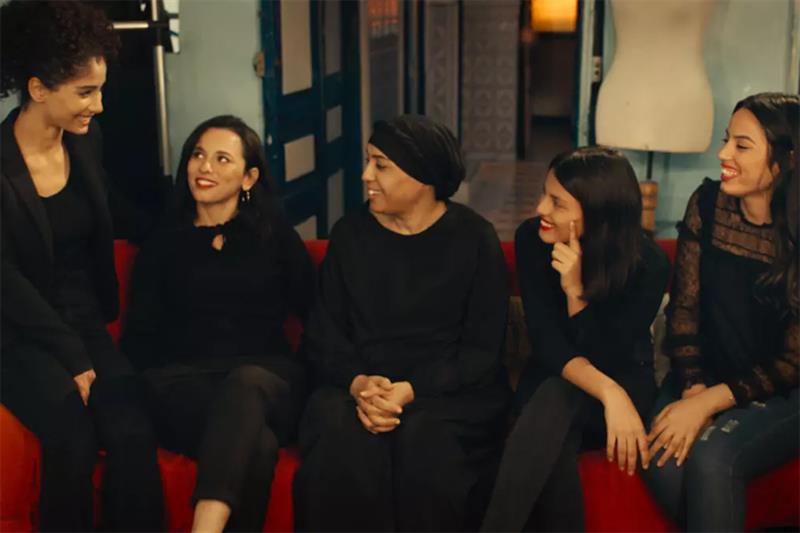
The film follows Olfa, a Tunisian woman and the mother of four daughters. One day, her two older daughters disappear. To replace them, the filmmaker Ben Hania invites professional actresses and invents a unique cinema experience which would lift the veil on Olfa and her daughters’ life stories.

The film blurs the boundaries between documentary and fiction and between being on-screen and off-screen.

The film has received critical acclaim, winning the Golden Eye award at the Cannes Film Festival, the Best International Film at the Munich Film Festival, and the Jury Award at the International Competition of the Brussels Film Festival. Most recently, it won the Asharq Award for Best Documentary at the Red Sea International Film Festival.

source/content: english.ahram.org.eg

_________

____________

TUNISIA

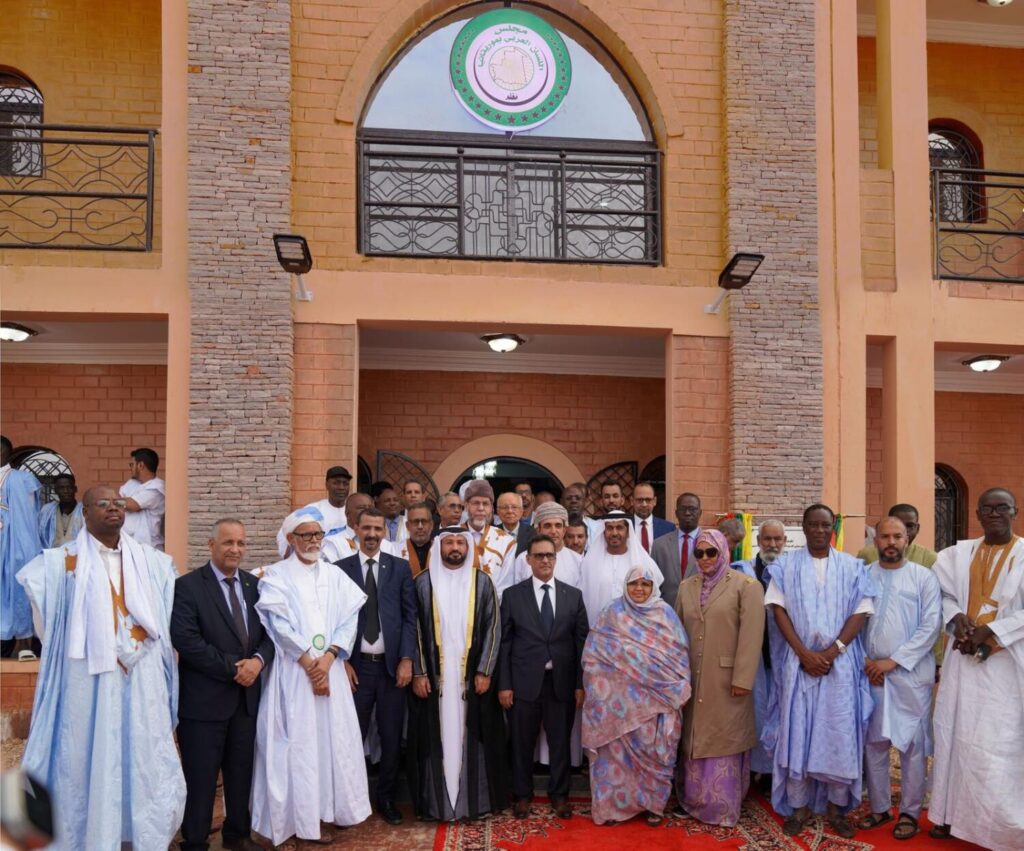
MAURITANIA – SHARJAH, U.A.E: New eco-friendly Headquarters of ‘Arabic Language Council, Mauritania’, funded by Sharjah Ruler, opens in Mauritania

The Academy will nurture the development of the language in Mauritania and beyond, bringing together an elite group of scholars dedicated to the cause.

The new headquarters of the Arabic Language Council in Nouakchott, Mauritania, was inaugurated on Monday under the patronage of Mauritania President Mohamed Ould Cheikh El Ghazouani, and through the contribution of His Highness Sheikh Dr. Sultan bin Mohammed Al Qasimi, Member of the Supreme Council and Ruler of Sharjah, and Supreme President of the Arabic Language Academy (ALA) in Sharjah.

Development of the Arabic language

Ahmed Sid Ahmed Dié, Mauritanian Minister of Culture, Youth, Sports and Relations with Parliament, presided over the ceremony, expressing gratitude for the generous contribution from Sheikh Dr. Sultan. The Academy in Mauritania will nurture the development of the Arabic language in Mauritania and beyond, bringing together an elite group of scholars dedicated to this noble cause.

The ceremony was also attended by several senior diplomatic and media figures, as well as heads of Arab language academies.

During the event, Mohamed Hassan Khalaf, an ALA Board of Trustees member and Director-General of the Sharjah Broadcasting Authority, conveyed a message to the community of linguists and researchers in Mauritania from the Ruler of Sharjah. He also spoke about the importance of supporting major scientific projects and continuous efforts to empower the Arabic language in various countries worldwide, highlighting the strong relationship between the UAE and the Mauritania.

Championing Islamic and Arabic culture

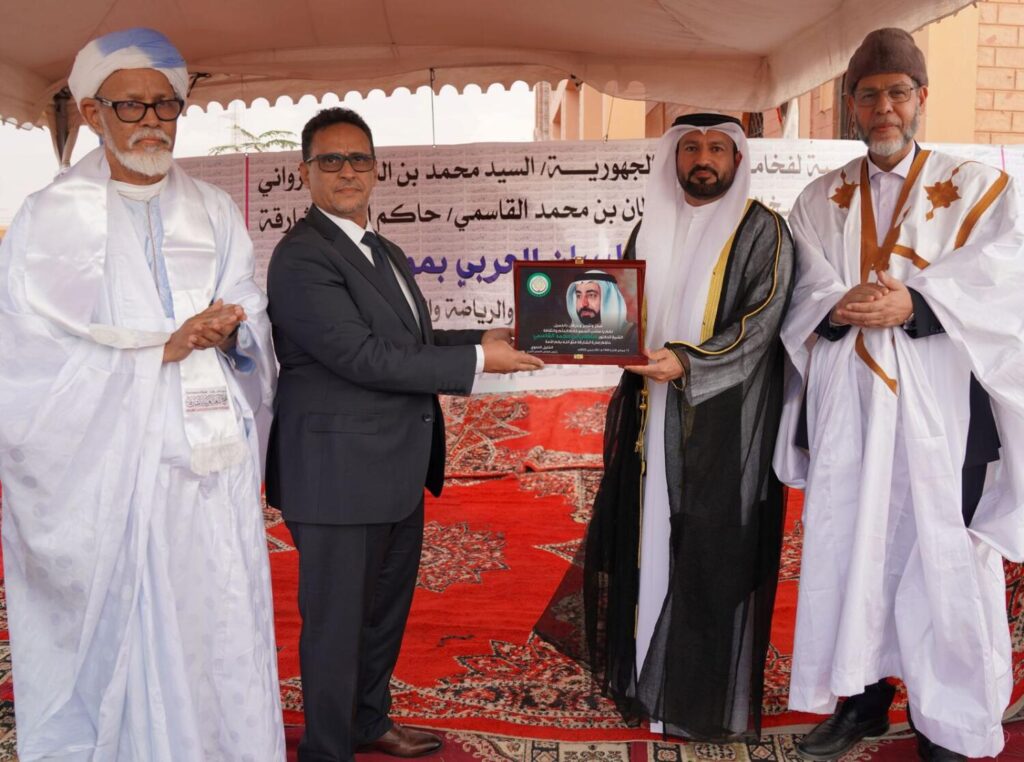
Ahmed Sid Ahmed Dié presented a commemorative shield to the Ruler of Sharjah, and was received by Mohamed Hassan Khalaf in appreciation of Sheikh Dr. Sultan’s efforts in championing Islamic and Arabic culture and language, in various countries around the world.

Dr. Khalil Al Nahwi, Chairman of the Arabic Language Council in Mauritania, delivered a speech congratulating the attendees, the entire Mauritanian population and all guardians of the Arabic language. He also reviewed the council’’s achievements over the past five years, praising the support it receives directly from the Ruler of Sharjah and the Arabic Language Academy in Sharjah.

Ahmed Sid Ahmed Dié, along with Mohamed Hassan Khalaf and Dr. Mohamed Safi Al Mosteghanemi, Secretary-General of ALA, unveiled a commemorative plaque marking the opening of the building before the ceremonial cutting of the ribbon, and was followed by a tour of the impressive building, designed in the Mauritanian architectural style.

Built with eco-friendly materials, the new headquarters consists of two floors and includes several administrative offices, study halls, meeting rooms, and an expansive library. The main building is accompanied by a hall named Al Qasimiya Hall to be used for seminars and events. The headquarters also houses a mosque that can accommodate more than 300 worshippers.

Situated in the University district on land provided by the Mauritanian government, the entire construction and furnishing of this significant establishment were funded by the Ruler of Sharjah.

source/content: khaleejtimes.com (headline edited)

___________

___________________________________

MAURITANIA / SHARJAH, U.A.E

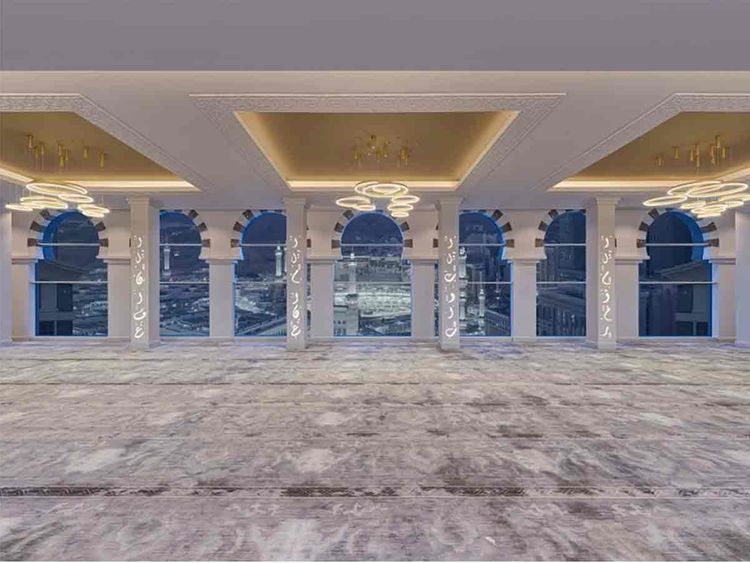
SAUDI ARABIA: ‘World’s Highest Hanging Prayer Room’ opens with Spectacular view of Kaaba and other Religious Landmarks in Mecca

Saudi Arabia’s record-breaking hanging prayer room offers spectacular Kaaba views.’

Saudi Arabia has set a new world record with the opening of the highest hanging prayer room, as recognised by Guinness World Records.

Situated at a breathtaking 483 meters above sea level, this architectural marvel offers unparalleled views of the Kaaba and other significant religious landmarks in Mecca.

Nestled within the bridge connecting the two towers of the Address Jabal Omar Mecca Hotel, the prayer room is not just a feat of engineering but also a testament to architectural ingenuity and creative prowess.

Using the latest technology and specially designed equipment, the 650-tonne steel bridge was initially assembled at 312 meters above ground before being elevated to its final position, linking the hotel’s twin towers across floors 36, 37, and 38.

The hall, which can accommodate up to 520 worshippers in a spacious 550 square meter area, blends traditional Arabic designs with modern luxury. Arabic calligraphy adorns its interiors, enhancing the room’s sanctity with the names of Allah and reflecting the rich Islamic heritage.

Worshippers in this prayer hall are treated to a spiritual experience filled with peace and tranquility. During Fajr prayers, they can witness the sunrise over Mecca, while the sunset bathes the chapel in warm.

source/content: gulfnews.com (headline edited)

_________

It was initially assembled at 312 meters above ground before being elevated to its final position, linking the hotel’s twin towers across floors 36, 37, and 38. / Image Credit: Courtesy of X/@ThamerAlbugami

__________________

SAUDI ARABIA

LEBANON: Looking back on the life of ‘Lebanese Picasso’ Hussein Madi

Renowned artist who died in Beirut this week spent 2 decades studying and working in Rome, and had his work showcased across the world.

The veteran Lebanese master Hussein Madi, renowned for his vibrant paintings, has died in Beirut. Often called the “Lebanese Picasso,” Madi crafted his own visual language, peppered with bird motifs, curvy women, and geometrical symmetry, that made his bold oeuvre look instantly recognizable amongst Arab art enthusiasts.

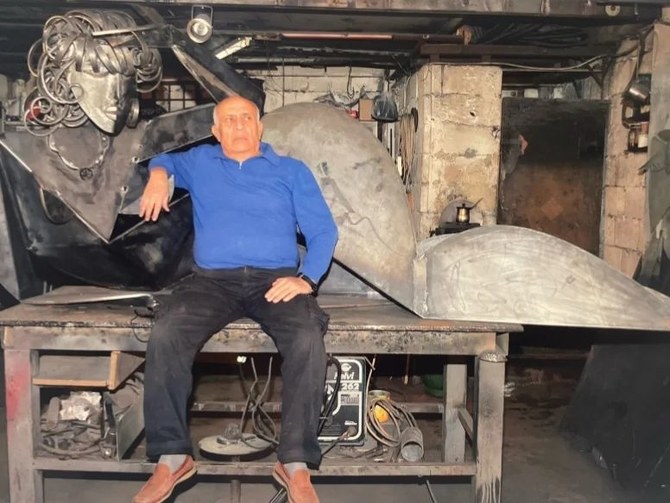
Fellow artists and gallerists took to social media to offer their condolences. On Instagram, the Lebanese artist Abed Al-Kadiri posted some old snapshots of Madi in his studio and wrote. “Today at his burial ceremony Madi joined his flock of birds, flying alone, united with himself, just as he always lived.”

Maliha Tabari, founder of Dubai’s Tabari Artspace, said that Madi was the first artist she worked with in 2003, which proved to be an invaluable experience. “I’ll never forget the afternoons that would turn to evenings spent on his balcony in Beirut, delving into intense discussions of form explained by him through the curve of a pomegranate or a bird’s wing,” Tabari posted. “We lost not only a key figure from our region’s art journey, but also a father figure.”

Madi, who was also a sculptor, printmaker, educator and press illustrator, was born in the southern Lebanese town of Shebaa in 1938. While his parents reportedly did not approve of his artistic pursuits, it was his encouraging grandfather that saw potential in Madi. He left his parents’ home at the tender age of 19. He reportedly supported himself financially by submitting caricatures to newspapers in Lebanon and Iraq.

In the early 1960s, Madi was a student at the Lebanese Academy of Fine Arts. He later went on to have an international education, by traveling to the exciting art capital of Rome, in 1963, where he enrolled at the Accademia di Belle Arti. 

He would spend nearly the next two decades of his life in Rome, before returning for good to Lebanon in 1986, while the civil war was still happening. “I bitterly regret not having remained in Rome because of all the frustrations I endured since my return to Beirut. In fact, civil war drastically affected the course of my life,” Madi once said.

In Lebanon, Madi devoted himself to his canvas, showcasing his work in several art galleries in Beirut. For 10 years, starting in 1982, Madi was also president of the Lebanese Art Association. 

Madi’s paintings offer a visually appealing melange of thick lines, repetitive patterns, angular shapes, natural scenes, and bright colors. There is an element of spontaneity, presented in an orderly fashion. His images are also populated with figures, holding a book, a musical instrument — or simply reclining. “Despite all the mishaps, I was deeply happy. My work celebrated life,” he said.

Over the years, Madi’s artworks have been featured in auction sales at Christie’s and Sotheby’s. His works have also been acquired by regional and international art institutions including the Barjeel Art Foundation (Sharjah), Dalloul Art Foundation (Beirut), Mathaf: Arab Museum of Modern Art (Doha), Jordan National Gallery of Fine Arts (Amman), British Museum (London) and Institut du Monde Arabe (Paris).

source/content: arabnews.com (headline edited)

____________

Renowned artist Hussein Madi who died in Beirut this week spent 2 decades studying and working in Rome, and had his work showcased across the world. (Instagram)

_____________

LEBANON

SAUDI ARABIA hosts ‘Islamic World Educational, Scientific and Cultural Organization’s (ICESCO) 44th session of Executive Council

Event will cement the Kingdom’s efforts to promote cultural communication and exchange, scientific and social development.

Saudi Arabia, represented by its National Commission for Education, Culture and Science, is hosting the 44th session of the executive council of the Islamic World Educational, Scientific and Cultural Organization in Jeddah from Jan. 16 to Jan. 18.

ICESCO media department told Arab News: “The proceedings of the executive council of the 44th Islamic Educational, Scientific and Cultural Organization will kick off in Jeddah, Saudi Arabia on Tuesday (Jan. 16, 2024) with the participation of 54 member states. The event will run until Thursday.”

As the representative of the Kingdom, the NCECS said that hosting the event comes as part of the support provided to the education, culture and science sectors. It is also indicated the Kingdom’s role in driving forward educational, cultural and scientific development, both regionally and globally, it said.

Among the items on the executive council agenda are future strategies and action plans. The organization’s budget will also be discussed.

The council’s final recommendations will be handed over and included in a report to be endorsed by the ICESCO’s biannual general conference, the organization’s policy governing body event.

Prince Badr bin Abdullah bin Farhan, minister of culture and chairman of the NCECS, said: “The event will cement the Kingdom’s efforts aiming at creating spheres of cultural communication and exchange as well as scientific and social development. These sectors are considered to be cornerstones for developed human societies.”

As a prominent member of ICESCO, it is the strategy of the Kingdom to pursue all avenues supporting the organization’s goals in the best interests of the Muslim world.

Operating under the Organization of Islamic Cooperation, ICESCO is an intergovernmental organization specializing in the development of education, science and culture. Established in 1982 with its headquarters in Rabat, Morocco, ISESCO acts in line with the OIC’s general strategy aimed at achieving sustainable development in these sectors across all Muslim states.

source/content: arabnews.com (headline edited)

IRAQI Artist Ali Al-Rawi Breaks Guinness World Record with Giant Drawing

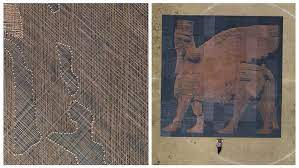
 An Iraqi artist celebrated his culture and history by recreating a mythical beast in a whopping piece of art that took him a whole year to complete, according to Guinness World Records.

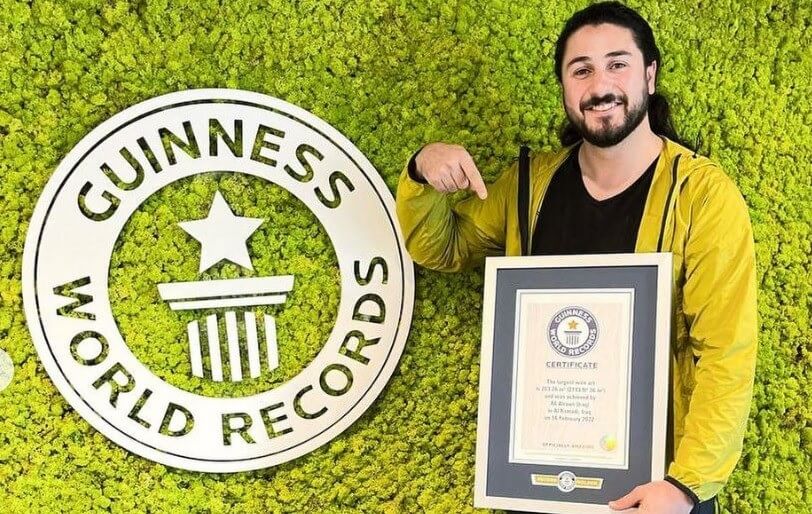
The Iraqi young artist, Ali Al-Rawi, created a work of art depicting the ancient Assyrian winged bull by wrapping copper wires around nails attached to wooden boards to create the largest wire art, measuring 203.76 square meters.

The Assyrian winged bull, known as ‘The Lamassu,’ is a mythological hybrid composed of the head of a human, the body of a bull, and the wings of a bird.

This giant artwork extends over the space of approximately 15 car parking spaces, and it took a whole year to complete.

Around 89 thousand nails and 250 kilograms of pure copper formed into wires of 35,714 meters were used on the surface of 18 wooden planks.

Al-Rawi works as a physician assistant in the city of Ramadi in the Iraqi western governorate of Anbar. His artistic talent grew from scribbling on a school bench to now creating epic pieces of art with wires.

Al-Rawi was inspired after seeing a German artist using that technique in 2016.

After a long search online, he couldn’t find anything to teach him how to do it, so he practiced until he mastered the technique on his own.

“I drew a sail at the beginning. But after that, it took me a lot of experimenting to select the usable materials,” Al-Rawi explained.

“I decided on copper wires and one-inch nails with small heads in order not to affect the shape of the work, to make sure the monuments insulate heat, moisture and scratching, as wood is also coated with three materials to serve this purpose,” Al-Rawi added.

Al-Rawi worked hard over the course of a year and had to cover the board’s entire dimensions with wires of different colors to meet the requirements of breaking the world record.

Al-Rawi moved the entire artwork to several different locations in Iraq to carry out the final measurements and filming.

source/content: iraqinews.com (headline edited)

_________

The Iraqi artist Ali Al-Rawi holding Guinness World Records certificate. Photo: Guinness World Records

pix: guinnessworldrecords.com

_________

IRAQ