SAUDI ARABIA : King Faisal Prize winners announced for 2026

Pioneering scientist behind revolutionary weight-loss drugs, global scholars, innovators among winners.

The King Faisal Prize 2026 winners were announced at a ceremony in Riyadh on Wednesday night.

The event honored pioneering scientists, global scholars and innovators for their transformative contributions to medicine, science, Arabic language, Islamic studies and the service of Islam.

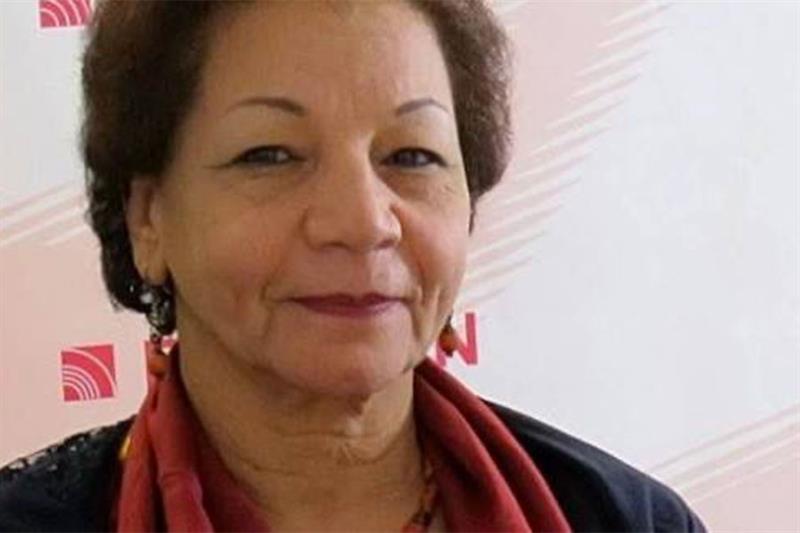
Prof. Svetlana Mojsov was named winner in the medicine section for her groundbreaking discoveries that are now reshaping how we treat obesity.

Prof. Carlos Kenig was announced as science laureate in the field of mathematics for helping to revolutionize understanding of nonlinear partial differential equations.

Mojsov, the Lulu Chow Wang and Robin Chemers Neustein research associate professor at The Rockefeller University in New York, pioneered research on glucagon-like peptide-1 (GLP-1) that has fundamentally transformed how obesity and diabetes are treated.

She discovered and characterized the biologically active form of GLP-1, a natural intestinal hormone that regulates blood sugar and appetite, and identified its receptors in the human pancreas, heart, and brain.

Through cutting-edge biochemistry and physiological studies, Mojsov demonstrated that GLP-1 powerfully stimulates insulin secretion while reducing hunger and managing glucose levels.

Her groundbreaking work enabled the development of an entirely new class of medications that mimic this natural hormone, sparking a paradigm shift in obesity treatment.

These therapies today provide life-changing benefits for hundreds of millions of people worldwide living with obesity and its complications — a global health crisis affecting 890 million adults and 160 million children and adolescents in 2022 alone, according to the World Health Organization.

Mojsov’s groundbreaking contributions have earned numerous prestigious honors, including Time magazine naming her one of the 100 Most Influential People in 2024.

Kenig was honored for his groundbreaking contributions to mathematical analysis. His work has transformed understanding of nonlinear partial differential equations — the mathematical equations describing how things change and move in the physical world — and provided researchers with a now-ubiquitous set of techniques. His insights have opened new research frontiers with applications spanning fluid mechanics, optical fibers, and medical imaging.

Kenig, the Louis Block distinguished service professor at the University of Chicago, is recognized for applying harmonic analysis techniques across different areas of partial differential equations.

His work on free boundary problems — determining unknown boundaries such as where ice meets melting water or how fluids flow through soil — has been particularly influential.

Kenig has spent three decades figuring out how complex waves behave over long periods of time, especially in tricky situations where they could either spread out peacefully or build up dangerously.

This matters for understanding everything, from ocean waves to light pulses in fiber optics and to how energy moves through different materials.

His work helps explain phenomena in quantum mechanics, optics, and ocean waves. By combining different mathematical techniques, he has solved longstanding problems that had puzzled mathematicians for decades.

In addition to medicine and science, the King Faisal Prize recognized the achievements of outstanding thinkers and scholars in the field of Arabic language and literature, Islamic studies, and exemplary leaders who have played a pivotal role in serving Islam, Muslims, and humanity at large.

Pierre Larcher, an emeritus professor of Arabic linguistics at Aix-Marseille University and emeritus researcher at the Institute for Studies and Research on the Arab and Muslim Worlds, won this year’s King Faisal Prize for Arabic Language and Literature on “Arabic literature in French.”

His novel presentation of Arabic literature to French readers has earned widespread acclaim from critics and specialists, while his rigorous scholarly approach to classical Arabic literature has made it accessible and appropriate for French culture.

His critical translation project of “Al-Mu’allaqat” and rigorous study of pre-Islamic poetry demonstrate exceptional scholarly depth.

For this year’s Islamic Studies Prize, Abdelhamid Hussein Mahmoud Hammouda, the professor of Islamic history and civilization at Fayoum University, and Mohamed Waheeb Hussein, the professor of archaeology and history of art at the Hashemite University, were announced as co-laureates.

Hammouda’s work encompasses the trade routes across the Islamic world — the Mashreq, Iraq and Persia, Arabian Peninsula, Greater Syria, Egypt, Sahara, Maghreb, and Al-Andalus. This expansive scope delivers coherent understanding of Islamic trade trajectories across history, serving as an authoritative reference for both specialized research and broader scholarship.

Hussein’s groundbreaking work uses archaeological surveys, GPS documentation, and analytical mapping to systematically correlate Qur’anic texts with geographical data. His research offers definitive scholarly interpretation, significantly advancing documentation of early Arabian Peninsula trade routes.

Sheikh Abdullatif Al-Fozan and Dr. Mohammad Abou Moussa were announced as co-laureates in the Service to Islam Prize.

Laureates’ names were announced by Prince Turki Al-Faisal and the King Faisal Prize’s Secretary-General Dr. Abdulaziz Alsebail.

Selection committees included experts, specialists, and scholars who met in Riyadh and examined the nominated works. They selected the laureates in an objective and transparent manner, in accordance with the rules and regulations.

The KFP was established in 1977, and was awarded for the first time in 1979 in three categories: service to Islam, Islamic studies, and Arabic language and literature. Two additional categories were introduced in 1981: medicine and science. The first medicine prize was awarded in 1982, and in science two years later.

Since 1979 the KFP has given awards to more than 300 laureates who have made distinguished contributions to different sciences and causes.

Each prize laureate is endowed with $200,000, a 24-carat gold medal weighing 200 grams, and a certificate inscribed with the laureate’s name and a summary of the work that qualified them for the prize.

source/content: arabnews.com (headlines edited) 

_____________

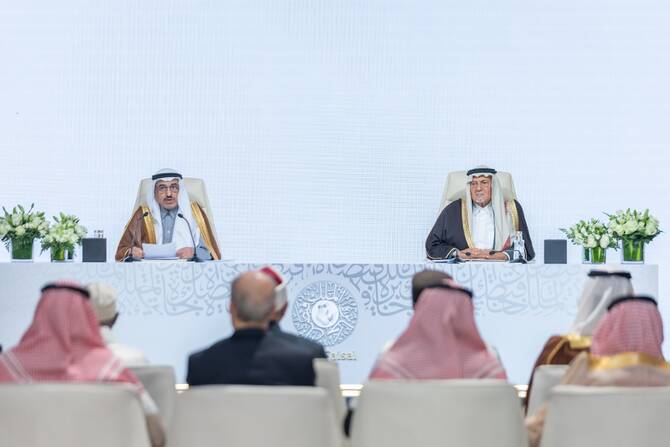
King Faisal Prize laureates’ names for 2026 were announced in Riyadh on Wednesday night by Prince Turki Alfaisal and the Prize’s Secretary General Dr. Abdulaziz Alsebail. (Supplied)

_______________________________________________________

EGYPT / JORDAN / PALESTINE / SAUDI ARABIA (*Arab)


ARAB Media Forum Opens in Beirut: Minister Morcos Honors Prominent Journalists

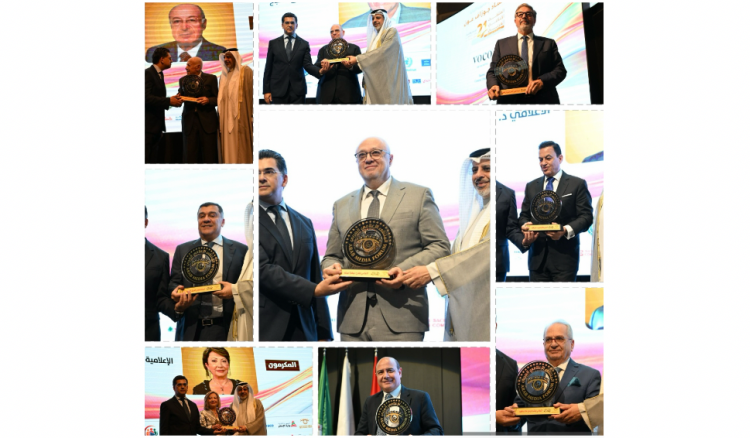
The Arab Media Forum kicked off in Beirut on Wednesday with an opening ceremony honoring a group of distinguished journalists and media figures. Minister of Information Dr. Paul Morcos and Secretary-General of the Arab Media Forum Madi Abdullah Al-Khamis presented the awards.

Honorees included Yolande Khoury, Rafic Khoury, Jacques Wakim, Nicolas Sabbagh, producer Sadiq Al-Sabah, Dr. Sami Kleib, Mounir Al-Hafi, Fares Yawakim, and Rose Farah Zamel (Warda), among others. 

The event also recognized MEA Chairman Mohammad El-Hout, research CEO Mohammad Ali, Voco Hotel GM Roy Yougharios, and Phoenicia Hotel Director Marie Choueiri.

Minister Paul Morcos himself was also honored for his role in reviving Lebanon’s media vision and strengthening Arab media cooperation.

source/content: nna-leb.gov.lb (headlines edited0

______________

________

ARAB

ALGERIAN Professor Waciny Laredj wins UAE-based Great Arab Minds Award in Literature and Arts

Sheikh Mohammed bin Rashid praises novelist’s insights into intricacies of Arab societies.

His Highness Sheikh Mohammed bin Rashid Al Maktoum, Vice President and Prime Minister of the UAE and Ruler of Dubai, congratulated Algerian Professor Waciny Laredj on winning the Great Arab Minds Award in Literature and Arts.

The novelist, short story writer and academic is one of the Arab world’s most prominent literary figures and well-known throughout the Arabic-French speaking countries.

“We congratulate Professor Waciny Laredj on winning the Great Arab Minds Award in Literature and Arts, honouring his exceptional literary contributions. Professor Waciny has presented over 30 novels that delve into the intricacies of Arab societies, culture, and the environment. His impactful works have been translated into more than 20 languages and endorsed by numerous universities worldwide,” Sheikh Mohammed said in a congratulatory message posted on his official X account.

“Holding the esteemed position of Chair Professor at the Central University of Algiers and the Sorbonne University in Paris, Professor Waciny’s achievement is a testament to his remarkable dedication to literature. We commend his efforts and deeply appreciate his profound contributions to Arabic literature, enriching the global readership.”

source/content: gulfnews.com (headline edited)

______________

Laredj’s works have been translated into over 20 languages and endorsed by numerous universities worldwideX/@HHShkMohd

_____________

ALGERIA

EGYPT : Sarah Goher Among Variety’s ‘10 Directors to Watch’ List

Sarah Goher has become the first Egyptian director included in Variety’s “10 Directors to Watch” list.

Among the 10 emerging directors on Variety’s list are Kristen Stewart, Walter Thompson-Hernandez and Akinola Davies. Goher’s selection follows the runaway success of her debut feature film, Happy Birthday, a tender yet powerful story about class and longing, told through the eyes of an 8-year-old maid.

Goher co-wrote the script with Mohamed Diab; production is handled by Ahmed El Desouky, Ahmed Abbas, Ahmed Badawy, along with Hollywood-heavyweights Jamie Foxx and Datari Turner.

‘Happy Birthday’ premiered at the 2025 Tribeca Film Festival, winning Best International Narrative Feature, Best Screenplay and the Nora Ephron Award for Outstanding Female Director.

The film was also Egypt’s official submission to the Oscars.

source/content: cairoscene.com (headline edited)

______________

____________

EGYPT

EGYPT’s Salwa Bakr wins inaugural BRICS Literary Prize in Russia

Egyptian novelist Salwa Bakr has won the inaugural BRICS Literary Prize, receiving one million Russian rubles at a ceremony in Khabarovsk, Russia.

The first edition of the prize drew nominees from across the BRICS bloc—Brazil, Russia, India, China, and South Africa—as well as the United Arab Emirates.

Bakr’s victory reflects the growing international recognition of Arab authors on major literary platforms.

The BRICS Prize Board of Trustees had previously announced a longlist of 27 writers competing in the literature category.

Egyptian authors included Ibrahim Abdel Meguid, Salwa Bakr, and Fathi Imbabi, alongside UAE writers Sheikh Ali bin Tamim, Maisoon Saqr, and Reem Al Kamali.

The longlist also featured Russian writers Alexey Varlamov, Andrey Gelasimov, and Dmitry Danilov; Brazilian authors Ana Maria Gonçalves, Patrícia Melo, and Ricardo Aleixo; Indian writers Jay Vasavada, Dr. Rajan Kumar.

It also included Sonu Saini; Chinese authors Ma Boyong and Ai Yi; South African nominees Ntabiseng Jah Rose Jafta, Bongiwe Mhlongo, and Zainab Khan; Ethiopian writer Abere Adamu; Iranian authors Mansour Ali Moradi, Majid Ghasemi, and Reza Amerihani; and Indonesian writers Ekasakti Panu, Intan Paramaditha, and Deni Jha.

The winner receives a cash prize, a commemorative shield and a certificate of appreciation.

Organizers said the award aims to promote cultural exchange among BRICS nations and highlight literature’s role in advancing shared human values, including solidarity and peace.

Salwa Bakr (born 1949, Cairo) is a renowned Egyptian writer, novelist, and critic. She is the author of seven short story collections, seven novels, and a play.

Bakr graduated from Ain Shams University and has worked as a film and theatre critic for leading Arab publications, as well as a professor at the American University in Cairo.

Her works, including the novel The Golden Chariot, often explore the lives of the disadvantaged and marginalized, with a particular focus on the challenges faced by women in Egyptian society.

Bakr’s books and stories have been translated into numerous European languages. Her novel The Man from Bashmour was selected for the Arab Writers Union’s list of the 100 Best Arabic Novels.

She has received the Deutsche Welle Literary Prize and is a member of Egypt’s Supreme Council for Culture and the Egyptian Writers’ Union.

The award was established by participants of the BRICS Forum “Traditional Values” in Moscow, November 2024.

source/content: english.ahram.org.eg (headline edited)

______________

__________

EGYPT

EGYPTIAN Islamic scholar and geologist Zaghloul El-Naggar dies aged 92

Egyptian Islamic scholar and geologist Zaghloul El-Naggar, a leading figure in the field of scientific interpretation of the Qur’an, has died at the age of 92.

El-Naggar passed away in Amman, Jordan, after a battle with illness, according to statements released on his official social media accounts on Sunday.

His funeral prayer will be held on Monday at Abu Aisha Mosque in Amman, followed by burial at Umm Al-Qutain Cemetery.

Born on 17 November 1933 in the village of Mashal in Egypt’s Gharbia Governorate, El-Naggar showed an early passion for science.

He graduated with honours in geology from Cairo University in 1955, earning the Mustafa Baraka Award in Earth Sciences. He obtained a PhD from the University of Wales in 1963 and became a full professor in 1972.

El-Naggar’s career spanned decades of teaching and research at universities in Egypt, the UK, Saudi Arabia, Qatar, Yemen, Jordan, and the United States.

He chaired the geology department at Qatar University, taught at King Fahd University of Petroleum and Minerals, and served as a visiting professor at UCLA.

He also directed Al-Ahqaf University in Yemen and later taught at the World Islamic Sciences and Education University in Jordan.

He became one of the Arab world’s most recognised voices on the relationship between science and faith, authoring numerous books and delivering hundreds of lectures on what came to be known as the “scientific miracles of the Qur’an and Sunnah”.

His popular TV programme Ayat Bayyinat (“Clear Verses”) aired across Arab channels, exploring Quranic descriptions of natural phenomena.

El-Naggar was a member of the International Commission on Scientific Signs in the Qur’an and Sunnah and was honoured several times for his contributions to promoting scientific understanding within an Islamic framework.

source/content: newarab.com (headline edited)

______________

El-Naggar passed away in Amman, Jordan, after a battle with illness [Al-Araby Al-Jadeed]

__________

EGYPT

ARAB LITERATURE : New research rewrites the story of Arabic literature’s ‘lost century’

Experts at Frankfurt Book Fair bring to light evidence that writing never faded after Abbasid period.

Arabic literature is still partly shaped by a story written in Europe more than a century ago.

It begins in the eighth century, when Baghdad under the Abbasid caliphs became a centre of science, philosophy and poetry – a period regarded as the golden age of Islamic civilisation.

At the heart of that era were poets such as Abu Nuwas and Al Mutanabbi, alongside polymath philosophers Al Farabi and Avicenna, who came to represent the height of an Arabic intellectual culture that illuminated the world.

This framing emerged from 19th century European scholars, including France’s Ernest Renan and the Netherlands’ Reinhart Dozy, who argued that Arabic intellectual life then declined after the 11th century, leading to an 800-year lull before Europe’s Renaissance.

It is a view steeped in Orientalist bias and historical oversimplification, current scholars say, as the Arabic literature never fell silent.

Speaking at a panel organised by the Sheikh Zayed Book Award at the Frankfurt International Book Fair,  linguists and literary historians noted that Arabic writing continued to evolve in that it was copied, performed and translated, even when not formally acknowledged.

These reassessments underpin the work of modern researchers such as Germany’s Beatrice Gruendler, German–Turkish scholar Hakan Ozkan and American academic Maurice Pomerantz of NYU Abu Dhabi, who argue that Arabic literature developed unabated.

Gruendler describes the idea of a “lost century” in Arabic literature as a myth. Her non-fiction work The Rise of the Arabic Book, recently shortlisted for 2025 Sheikh Zayed Book Award for Arab Culture in Other Languages, recalls the thriving and competitive literature and publishing industry in ninth century Baghdad that echoes in book fairs today.

“You had professional copyists, bookshops and reading public,” she says. “If you walked through Baghdad, you would have seen scribes taking commissions, arguing over punctuation, advertising their handwriting. It was noisy, competitive and entirely familiar.”

That fact alone, she says, challenges the idea that formal publishing began in the 15th century in Germany with the arrival of Johannes Gutenberg’s printing press.

A reason behind the Western narrative about Arabic literature, she says, lies in the way European Orientalists thought of a civilisation’s trajectory.

“They wanted Arab history to look like theirs, with a beginning, a peak and a fall,” she says. “But Arabic literature doesn’t fit that pattern. It never stopped moving.

“The centres changed from Baghdad to Cairo to Damascus to Andalusia, but the conversation continued. The same poems were copied and reinterpreted, new genres appeared and older ones were reshaped. The language adapted to every place it went.”

That continuity can also be traced through poetry. Ozkan, professor of Arabic literature at France’s Aix–Marseille University, explores the topic in his study The History of the Eastern Zajal: Dialectal Arabic Strophic Verse from the East of the Arab World, shortlisted this year for the Sheikh Zayed Book Award in the category of Arabic Language and Literature.

The research shows how zajal, a rhythmic, dialect–based form of poetry long dismissed by both European and Arab academics as uncouth, continued to evolve long after the Abbasid period.

“These poets broke rules because they could,” he says. “They mixed registers, played with rhyme, mocked scholars and praised saints. Some of it reads like early rap. It’s the sound of a culture that’s alive.”

Further restoration is also happening at New York University Abu Dhabi with its Library of Arabic Literature, a series that helps bring back works from the supposedly lost centuries after the Abbasid period. Published in Arabic and English, it has already produced more than 60 volumes of prose, poetry and philosophy since its launch in 2010.

“Editing these books is like joining a conversation that never stopped,” said Maurice Pomerantz, one of the series editors and a professor of literature at NYU Abu Dhabi. “You can see generations of writers answering one another, authors, commentators, translators, all adding layers. The manuscripts are alive with argument.”

As for why the idea of Arabic literature’s decline took shape over the years, Pomerantz says it has less to do with history than with access. “If a text isn’t translated, it doesn’t exist globally,” he says.

“That’s why awards and institutions matter. The Sheikh Zayed Book Award, for example, recognises scholarship about Arabic culture written in any language. It brings visibility to research that might otherwise stay inside the academy.”

He adds that the real challenge now is ensuring these works live beyond academic circles. “We need to make them part of the public imagination again, taught in schools, read in translation, performed on stage. Otherwise the myth will just grow back.”

source/content : thenationalnews.com (headline edited)

________________

__________

ARAB

EGYPT : A world spectacle for history – Grand Egyptian Museum (GEM) inaugration November 01st, 2025

After more than 20 years in the making.

In an evening that blended history, culture and global celebration, President Abdel-Fattah Al-Sisi and First Lady Entissar Al-Sisi presided over the official inauguration of the Grand Egyptian Museum (GEM) on Saturday, marking a milestone in the modern cultural landscape of Egypt and the world. The ceremony was attended by nearly 80 high-level delegations, including kings, presidents, princes, heads of government, and representatives of regional and international organisations.

Among them was German President Frank-Walter Steinmeier, Dutch Prime Minister Dick Schoof, Spain’s King Felipe VI, Queen Rania of Jordan, Prince Albert II of Monaco, and Greek Prime Minister Kyriakos Mitsotakis. Also present were Palestinian President Mahmoud Abbas, Saudi Arabia’s Minister of Culture Badr bin Abdullah, and the crown princes of Oman and Bahrain.

Held at the GEM’s open-air court overlooking the Giza Plateau, the celebration unfolded as a multisensory homage to Egypt’s timeless civilisation. Performances combining music, light, laser projection, and drone choreography traced the evolution of Egyptian architectural genius, from the Giza Pyramids to the modern era, and highlighted the message that civilisations thrive in times of peace.

The façade of the museum became a canvas for immersive light and projection displays, with vast screens illuminating Egypt’s ancient monuments and artistic heritage. Dancers in Pharaonic-inspired costumes, adorned with gold crowns and sceptres, performed to a live international orchestra, while fireworks and synchronised drone formations traced the silhouettes of ancient deities across the night sky.

President Al-Sisi welcomed the distinguished guests and emphasised that the GEM, now the largest museum in the world dedicated to a single civilisation, stands not merely as a showcase of ancient treasures, but as a testament to the creative spirit and enduring legacy of the Egyptian people.

He also described the museum as a new chapter in Egypt’s cultural story, affirming that it stands as a testament to the creativity and legacy of the Egyptian people and as a space for dialogue, knowledge, and exchange.

The ceremony began with the performance “The World Plays One Melody”. The programme featured a laser and drone show illustrating the Orion Belt alignment and its symbolic connection between the museum and the Giza Pyramids, followed by a performance titled “A Journey of Peace in the Land of Peace”.

The sequence highlighted the evolution of Egyptian architectural ingenuity, from the Step Pyramid of Djoser to modern Egyptian design, accompanied by a Coptic hymn of Sufi spiritual singing, and a drone message reading: “Civilisations Flourish in Times of Peace.”

The evening’s performances brought together some of Egypt’s most celebrated voices. Soprano Fatma Said and tenor Ragaaeddin delivered stirring pieces composed by Hisham Nazih, whose music blends contemporary orchestration with the tonal motifs of ancient Egypt, a style previously showcased during the Golden Mummies parade.

Sisters Amira and Mariam Abu Zahra, granddaughters of renowned Egyptian actor Abdel-Rahman Abu Zahra, appeared in stylised Pharaonic attire, performing a violin duet accompanied by the Cairo Opera House Orchestra and international ensemble players under the baton of maestro Nayer Nagui.

The celebration also highlighted Egypt’s cultural diversity. Nubian singer Ahmed Ismail performed in the Nubian language, while Haneen Al-Shater sang in Arabic from a floating stage overlooking the Nile, symbolising Egypt’s enduring identity as a crossroads of civilisations.

Iconic Egyptian actress Sherihan delivered an evocative spoken tribute to ancient Egypt’s artistic legacy, set against sky projections of the Pyramids. She was followed by Sherine Ahmed, the first actress of Egyptian descent to play Eliza Doolittle on Broadway, who gave a powerful musical performance before Islamic chanter Ehab Younis offered a spiritual finale.

On giant screens above, scenes from celebrations in countries all over the world played out against the backdrop of Egypt’s ancient monuments.

Dozens of performers dressed in elaborate white costumes, as a symbol of peace, their foreheads crowned with golden wreaths and sceptres in hand, played traditional tunes as a laser show depicting the Pharaohs and fireworks lit up the night sky above the museum.

As the night drew to a close, a drone light show mapped the sky with hieroglyphs, Pharaonic figures, and the golden mask of Tutankhamun, shimmering above the Giza Plateau, an image that captured both the grandeur of the past and the cultural confidence of the present.

Among the many moments that captured global attention during the GEM’s opening ceremony was the appearance of 12-year-old Asser Ahmed Hamdi, whose poised and expressive performance resonated with viewers across Egypt and beyond. The young performer quickly became one of the most talked about faces of the event, representing a new generation engaging with the country’s cultural narrative.

Asser described his participation in the ceremony as a defining moment in his life. “I was very happy to be there, and proud that my effort represented Egypt in front of the world,” he said, explaining that his preparation for the role involved months of rehearsals and that he had been training in performance and acting for seven years. “When the opportunity came, I felt like a dream had been achieved.”

Performing before President Al-Sisi and dozens of world leaders brought initial nerves, he admitted, but the atmosphere on stage quickly shifted those feelings. “I was nervous backstage, but once I stepped onto the stage, I felt calm,” he said. After the performance, he exchanged a few words with the president, who praised his portrayal linked to the story of Tutankhamun.

Asser spoke with pride about standing before the golden mask of Tutankhamun and the monumental statue of Ramses II inside the museum. “I had seen them only in books and on TV, but standing in front of them at the GEM was something completely different,” he said. “I felt proud to be representing Egypt.”

Reflecting on the journey, he said, “All the effort in rehearsals was worth it. I’m grateful I could present something worthy of Egypt. I will always be proud that I was part of the opening of the GEM.”

Among the creative figures behind the opening night spectacle was Ahmed Essam, the artist and designer responsible for the fireworks and pyrotechnic displays that illuminated the GEM during the ceremony. Speaking about the experience, Essam described it as one of the defining moments of his career, noting that the preparations took several months of planning, rehearsal and technical coordination.

“It was an honour to be part of an event of this scale,” he said, explaining that the ceremony’s postponements provided valuable time to refine the visual narrative and ensure that the display matched the cultural weight of the occasion. Essam highlighted that working in a field he is passionate about has been central to his development. “I travel constantly to learn and experiment with new ideas. When you love what you do, you invest your whole self into it.”

Creating the fireworks show for the GEM opening, he noted, required an approach tailored to the museum’s identity as a celebration of ancient Egyptian civilisation. Colours, rhythms, and sequences were chosen to complement the architectural setting and underscore the narrative themes of heritage and renewal.

He was also quick to highlight the scale of teamwork behind the scenes. “What viewers saw was the result of a coordinated effort involving more than 150 people, from designers and technicians to support staff. Everyone worked with passion and commitment to present Egypt in the best possible light.

“The opening of the GEM is a landmark in Egypt’s cultural journey. The presence of President Abdel-Fattah Al-Sisi and world leaders underscored its importance. We are proud to have contributed to an event that showcased Egypt’s ability to inspire and captivate the world,” Essam added.

Soprano Said, who took the stage as one of the evening’s principal performers, revealed that the concert marked a deeply personal milestone for her as it was her first since becoming a mother.

“I recently gave birth to twins,” she said, “and I wasn’t sure I would be able to perform because the concert came so soon after the delivery. I was a little anxious. But my children gave me the strength and energy to take part in this extraordinary occasion.”

Her appearance added an intimate emotional layer to the celebration, reflecting both the resilience of artists and the symbolic continuity between generations that the museum itself seeks to embody.

Most of the international state leaders expressed their enthusiasm over the grand opening. In a diplomatic gesture that blended cultural appreciation with a touch of modern creativity, Danish Foreign Minister Lars Løkke Rasmussen presented Egypt’s Foreign Minister Badr Abdelatty with a LEGO replica of the Great Pyramid of Khufu, a symbolic gesture marking Denmark’s participation in the GEM’s opening and celebrating Egypt’s architectural heritage.

Zambian Minister of Tourism Rodney Sikumba noted his country’s appreciation for the commemorative gift presented to Zambia on the occasion of the GEM’s opening, a piece representing part of the GEM’s architectural model. He pointed out that the artefact will be placed on a temporary display in one of Zambia’s national museums, accompanied by an explanatory panel narrating its significance. The gesture, he said, reflects Zambia’s pride in taking part in this historic cultural moment and serves as a testament to the growing cultural ties between the two nations.

As with any major cultural event, public reaction to the GEM’s opening ceremony was not uniform. Such occasions naturally invite a spectrum of opinions, shaped by personal taste, expectations, and aesthetic preferences. While some critics viewed the event as more modest than anticipated, others praised its scale and artistic ambition, seeing in it a carefully curated blend of ancient symbolism and modern cultural expression. Supporters argue that the ceremony succeeded in presenting Egypt as both a guardian of a timeless civilisation and a dynamic cultural force in the present day — a duality at the heart of the museum’s identity.

* A version of this article appears in print in the 6 November, 2025 edition of Al-Ahram Weekly

source/content: english.ahram.org.eg (headline edited)

______________

__________

EGYPT

ARAB Fund for Arts & Culture (AFAC) Opens 12th Arab Documentary Photography Program. Last Date – December 15th, 2025

The call invites emerging photographers residing and working in the Arab region to develop documentary projects within a structured process.

Submissions are open for the 12th Cycle of the Arab Documentary Photography Program (ADPP) from the Arab Fund for Arts and Culture (AFAC), in partnership with the Prince Claus Fund and the Magnum Foundation, and with support from the Norwegian Embassy to Lebanon and Syria.

The call invites emerging photographers residing and working in the Arab region to develop documentary projects within a structured process.

Selected grantees receive three intensive workshops led by regional and international experts, tailored one-on-one mentorship sessions, and a production grant to complete their projects.

Since its inception in 2014, ADPP has supported more than 120 photographers across the Arab region, building a community of visual storytellers working on regional narratives.

Visit the AFAC website to learn more and apply.

The deadline for submission falls on December 10th, 2025 at 5:00 PM Beirut Time.

source/content: cairoscene.com (headline edited)

_______________

________________

ARAB / EGYPT

MOROCCO Is An Arab Country : Language, Culture, and the Living Fabric of Identity

Arab identity, in both historical and anthropological terms, has never been solely about genealogy.

Morocco is, in fact, an Arab country. While this assertion may appear self-evident, it has become a subject of debate in contemporary discourse. Some voices insist that Morocco’s identity lies exclusively in its Amazigh or North African roots, rejecting its place within the Arab cultural sphere. Yet, such claims overlook the complex processes through which cultural affiliations are formed, internalized, and lived. Moroccan Arab identity is neither imposed nor superficial; it is a deeply ingrained civilizational reality that is experienced, performed, and transmitted across generations.

Arab identity, in both historical and anthropological terms, has never been solely about genealogy. It is a cultural and civilizational framework, a shared language, religion, and set of symbolic practices, that transcends bloodlines and geography. The Arab Islamic expansion of the 7th-century introduced Arabic and Islam to what is known now as the Arab World, setting in motion a centuries long process of cultural integration. This integration was not a simple imposition, but a dynamic interaction between incoming and indigenous traditions, producing a distinctly Moroccan expression of Arabness. It is a process in which the Arab and the local coexist, interact, and mutually shape each other.

[First Illustration of surgical instruments in history] from Al-Zahrāwī, Al-Taṣrīf liman ‘aǧiza ‘an al-Ta’līf, 30th volume (Surgery). Bibliothèque Nationale du Royaume du Maroc (BNRM), as reproduced on the Islamic Studies Library Blog, McGill University

Morocco is, in fact, an Arab country. While this assertion may appear self-evident, it has become a subject of debate in contemporary discourse. Some voices insist that Morocco’s identity lies exclusively in its Amazigh or North African roots, rejecting its place within the Arab cultural sphere. Yet, such claims overlook the complex processes through which cultural affiliations are formed, internalized, and lived. Moroccan Arab identity is neither imposed nor superficial; it is a deeply ingrained civilizational reality that is experienced, performed, and transmitted across generations.

Language lies at the heart of this Arab identity. Classical Arabic became the medium of religious practice, scholarship, and literary expression, while Moroccan Darija evolved as a vernacular rooted in Arabic but enriched over centuries through interaction with Amazigh and Andalusi traditions, as well as later European influences. Computational linguistic analysis by Mrini and Bond (2018) found that approximately 42% of Moroccan Darija’s lexicon shares at least 60% similarity with Standard Arabic, while only about 3% aligns with French and 2% with Spanish. This demonstrates that, although Darija incorporates foreign and Amazigh influences, its core lexical foundation remains predominantly Arabic (Mrini & Bond, 2018, Putting Figures on Influences on Moroccan Darija from Arabic, French and Spanish Using the WordNet). This linguistic presence is more than practical; it is existential. Arabic provides the conceptual framework through which Moroccans think, communicate, and participate in a shared cultural universe. Anthropologists have long argued that language is the “house of being”, and in Morocco, Arabic offers that house, the structure within which Moroccan society organizes its collective life.

Yet Morocco’s Arab identity is not reductive. Its population is ancestrally diverse, encompassing Amazigh, Arab, sub-Saharan, Andalusi, and Mediterranean lineages. Rather than contradicting Arab identity, this diversity illustrates the inclusive, integrative nature of Arab culture, which historically has absorbed and harmonized a multitude of peoples and traditions. Being Arab in Morocco is thus defined not by ethnicity but by cultural practice, speaking Arabic, engaging with Islamic religious life, and participating in the intellectual and spiritual traditions of the Arab world. This identity is lived and internalized, a product of historical continuity and daily enactment.

Medersa Bou Inania in Fez

Moroccan Arabness is dynamic and regionally inflected, expressed through a mosaic of Arabic dialects that embody the country’s historical and cultural layering. The pre-Hilali urban dialects, such as Fassi, Meknassi, and Rbati Arabic, spoken in the historic cities of Fez, Meknès, and Rabat-Salé, preserve many features of early Andalusian and Classical Arabic, including the conservative pronunciation of qāf as /q/ and more formal morphosyntactic patterns. In contrast, the Jebli dialect of northern Morocco, prevalent in Tetouan, Chefchaouen, and the Rif region, blends Andalusian, Amazigh, and Spanish influences, producing softer phonetics and a Mediterranean lexicon. The Hilali or ‘Aroubi (Bedouin) varieties, dominant across the Atlantic plains, Chaouia, and Souss, descend from Arab tribal migrations and underpin the speech of rapidly urbanized centers such as Casablanca and Settat. Further south, the Marrakchi dialect represents a transitional form combining urban and Bedouin traits, while Judeo-Moroccan Arabic, historically spoken in Jewish communities in Fez, Essaouira, and Sefrou, incorporates elements from Hebrew and Spanish (Haketía). In the southeast, around Errachidia and the Tafilalet region, daily speech follows Hilali Bedouin patterns, but the area also preserves a rare, literary form of Filali Arabic used in Melhoun poetry and song, reflecting a deep historical connection to Classical Arabic and regional artistic expression. Further south and toward the Sahara, Hassani Arabic, a Bedouin variety influenced by Maghrebi and Saharan linguistic currents, illustrates the continued interplay of migration, trade, and cultural exchange in shaping Moroccan Arabic. Collectively, these dialects illustrate how Moroccan Arabic varies across geography and social history, forming a linguistically plural yet distinctly Arab national identity. These variations reflect the adaptability of the language and, by extension, the adaptability of Arab identity itself. Moroccan Arabness, therefore, is neither monolithic nor static; it evolves through time while maintaining continuity with a broader Arab cultural framework.

Describing Morocco as an Arab country is to acknowledge the primacy of this linguistic, religious, and cultural fabric. Arabic is not merely an official language; it is the deep structure of Moroccan society, shaping poetry, moral discourse, social interaction, and ritual life. Arab identity in Morocco is lived in the streets of Casablanca and Fez, in the rhythms of daily prayer, and in the idioms and expressions of everyday conversation. It is experienced through shared cultural symbols and practices that bind Moroccan society to the larger Arab world while remaining distinctively local.

Recognizing Morocco as an Arab country does not erase its rich cultural diversity; rather, it highlights the central role that Arab language, culture, and religion play in the nation’s historical and contemporary identity. Moroccan Arabness is a living, evolving phenomenon, formed through centuries of interaction, internalized through daily life, and transmitted through language, ritual, and social practice. It reflects a society that is at once rooted in its local context and deeply connected to the broader Arab civilization.

In conclusion, Morocco’s Arab identity is a complex, multidimensional reality, grounded in linguistic, religious, and cultural practices. It is the result of historical processes, dynamic interactions, and the continuous enactment of shared meanings. To affirm that Morocco is an Arab country is not to deny its diversity but to recognize the living fabric of its identity, a fabric woven from Arabic language, Islamic faith, and the symbolic systems.

source/content: moroccoworldnews.com (headline edited) / Hajar Lmortaji

_______________

Hajar Lmortaji

_______________

MOROCCO