Arabs & Arabian Records Aggregator. Chronicler. Milestones of the 25 Countries of the Arabic Speaking World (official / co-official). AGCC. MENA. Global. Ist's to Top 10's. Records. Read & Enjoy./ www.arabianrecords.org
This is the month in which Palestinians commemorate the Nakba, a catastrophe often described in historical accounts as having displaced some 750,000 people.
It is true that Israel expelled this number of Palestinians from the territories it occupied unlawfully during the 1948 War. Yet the victims of Israel’s seizure of lands that had not been allocated to it under the UN Partition Plan — territories it appropriated by force during the conflict — are many times that number. Official statistics indicate that nearly 5.9 million Palestinian refugees are registered with the United Nations Relief and Works Agency (UNRWA), in addition to countless Palestinians who settled in other Arab or foreign countries and became part of their host societies, so they are no longer officially classified as refugees.
All of these people are victims of the Nakba that befell the Palestinian people as a result of the establishment of a Jewish state on Palestinian land. This reality makes the Nakba far more than a passing historical episode. It represents a profound transformation that redrew the map of the Middle East and altered the destiny of an entire people.
When we look at the images commonly associated with the Nakba, they usually depict masses of Palestinians leaving their homes and carrying their belongings on their backs, as though the tragedy unfolded in a single day. But this is misleading. Photographs capture only the instance in which they are taken, whereas the Nakba was never a single moment or an isolated event in Palestinian history. It was a prolonged process that began during the British Mandate in Palestine and continued long after its end.
Throughout this process, more than 500 Palestinian towns and villages were destroyed. The Deir Yassin massacre, for example, took place even before the outbreak of the 1948 War, claiming the lives of more than 110 men, women and children. When we speak of the Nakba, therefore, we are speaking of the systematic dismantling of an entire society that had once been stable and deeply rooted in its land, a deliberate project aimed at erasing a people’s geographic and civilisational identity.
That project, moreover, has never truly ceased. What happened in Gaza, and what is now unfolding in the West Bank, reflects the continuation of the same logic: emptying the land of its inhabitants through expulsion, displacement or killing; transforming the identity of the place; and erasing its cultural character. This confirms that the Nakba was not confined to the war of 1948. It is an ongoing process that began before the war and continues to this day.
* A version of this article appears in print in the 28 May, 2026 edition of Al-Ahram Weekly
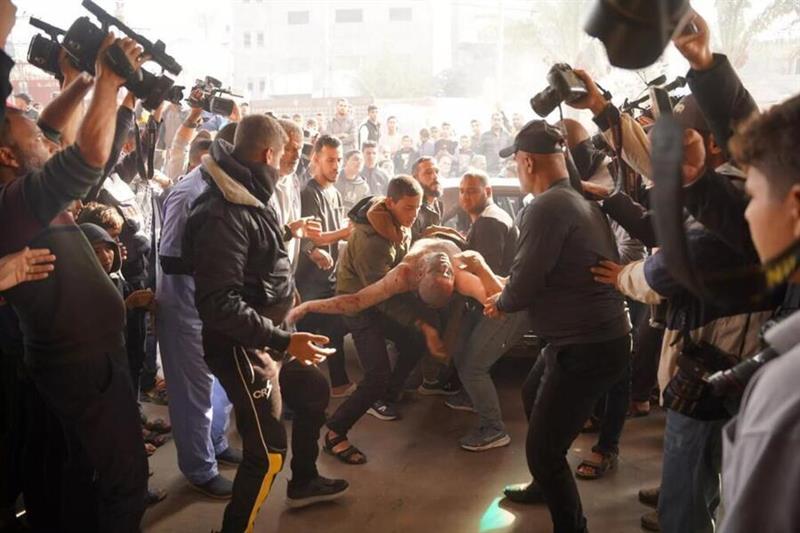
Professional photo and video journalists working in Gaza are to receive an annual press freedom award on Monday for risking their lives to report on the war, an association of publishers has said.
The 2026 Golden Pen of Freedom will be handed to representatives of global news agencies still operating in Gaza — Agence France-Presse, The Associated Press and Reuters — “whose local journalists continue to provide consistent, professional coverage under extremely challenging conditions”, said the World Association of News Publishers (WAN-IFRA).
“For over two and a half years, journalists in Gaza have recorded death, destruction, and human suffering in unparalleled terms,” reads the citation of the award.
“They are as much victims of the conflict as they are chroniclers of a war that erupted — and continues — around them.”
Since October 2023, Israel’s war on Gaza — documented by international experts as a genocide against the Palestinian people — has killed over 72,819, wounded 172,894 others, and forcibly displaced 90 percent of the population. The military campaign and crippling blockade have reduced the entire territory to rubble, destroying much of Gaza and sparking a severe humanitarian crisis in the strip that has at times crossed into famine.
To suppress the truth, Israel has systematically targeted the journalists documenting these atrocities.
Media rights group Reporters Without Borders (RSF) says Israeli forces have killed more than 220 journalists, at least 70 of whom were killed in the context of their professional duties.
AFP photographer Mohammed Abed, who worked in Gaza until April 2024 before joining its Cairo bureau, will be among those at the ceremony in the French city of Marseille.
The award “acknowledges the sacrifice and endurance of local Palestinian media professionals living and working in a war zone,” said WAN-IFRA, which holds its 2026 World News Media Congress from Monday to Wednesday.
“It also recognises colleagues injured and killed in the course of doing their job.”
The Israeli government has barred foreign journalists from independently entering the blockaded territory since the war began.
Despite the October 2025 ceasefire, Israel has continued near-daily attacks on the defenceless Palestinian population, killing at least 877 and injuring over 2,602 while refusing to lift its blockade or withdraw forces occupying up to 60 percent of the strip.
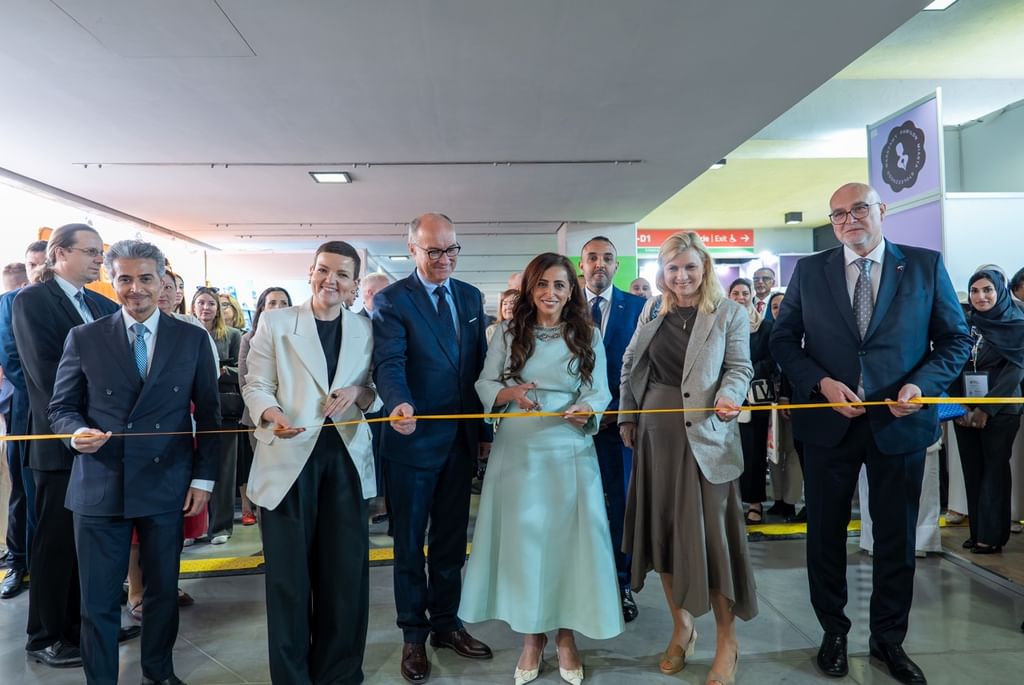
In the presence of Sheikha Bodour bint Sultan Al Qasimi, Chairperson of the Sharjah Book Authority (SBA), Sharjah officially opened its participation on Thursday as the first Arab Guest of Honour in the history of the Warsaw International Book Fair.
The emirate has brought to the European city a cultural project it has built over five decades, presenting a contemporary image of Emirati and Arab culture at one of Central Europe’s leading cultural events.
Sheikha Bodour Al Qasimi joined Włodzimierz Czarzasty, Marshal of Sejm of the Republic of Poland; the lower house of the Polish parliament, Marta Cienkowska, Poland’s Minister of Culture and National Heritage; Dorota Malinowska-Grupińska, Chairwoman of the Warsaw City Council, and Małgorzata Kidawa-Błońska, Marshal of the Polish Senate; at the opening ceremony of the fifth edition of the fair, which runs until 31 May at the National Stadium in Warsaw.
Following the ribbon-cutting, Sheikha Bodour Al Qasimi attended the opening ceremony, where she conveyed the greetings of His Highness Sheikh Dr. Sultan bin Mohammed Al Qasimi, Supreme Council Member and Ruler of Sharjah, and his wishes for the fair’s continued success.
She said His Highness has devoted his life to culture because he believes books create the kind of dialogue that allows civilisations to meet with dignity and depth. She recalled the Sharjah Ruler’s words: “Dialogue between civilisations is not an option, but a necessity. And culture is not an inheritance we keep to ourselves, but a noble bridge through which we connect with others.”
Sheikha Bodour added that Sharjah is proud to be the Guest of Honour in a country that understands language as memory, identity and continuity. Describing Warsaw as a city shaped by history and renewed by culture, she said it reminds us that culture does not merely survive history, but has the power to transform it.
She added that Arab and Polish cultures share a deep understanding of literature’s role, noting that poetry in both traditions remains central to how societies understand themselves and express memory, values and belonging across generations.
Sheikha Bodour said Sharjah’s theme at the fair, “Two Civilisations. One Language of Letters”, celebrates difference and reflects the belief that civilisations do not have to resemble one another to understand one another; they only need to approach each other with patience, curiosity and empathy.
In closing, she said that Sharjah comes to Warsaw not only with its stories but also with an open invitation to read one another, translate one another, and imagine together. She expressed hope that the fair would spark a dialogue that continues long after its conclusion and grows stronger between Warsaw and Sharjah.
Włodzimierz Czarzasty, Marshal of the Sejm of the Republic of Poland, said it was a cultural honour to welcome Sharjah as the Guest of Honour of Warsaw International Book Fair 2026, and described the emirate’s participation as a valuable cultural contribution that reflects the growing ties between Poland and the UAE.
He said books remain a powerful tool for fostering understanding and dialogue between cultures, while publishers continue to play a vital role in preserving and sharing knowledge across societies.
In her keynote, Marta Cienkowska, Poland’s Minister of Culture and National Heritage, thanked Sheikha Bodour for her remarks at the opening ceremony and praised Sharjah’s appreciation of Polish culture and history. She said cultural exchange remains a powerful means of fostering dialogue and understanding between peoples, adding that the Warsaw International Book Fair plays a vital role in connecting readers, writers and publishers with Poland’s cultural scene.
Dorota Malinowska-Grupińska, Chairwoman of the Warsaw City Council, said Sharjah’s participation as Guest of Honour highlights the role of books and publishing in fostering cultural dialogue and mutual understanding. As a publisher herself, she said books serve not only as cultural products but also as a means of human connection and exchange, adding that Sharjah’s presence in Warsaw brings a new dimension to dialogue with the Arab world.
For his part, Jacek Oryl, Director of the Warsaw International Book Fair, said Sharjah’s selection as Guest of Honour marks a significant moment in the fair’s history and reflects growing cultural ties between Poland and the UAE. He added that the emirate’s participation offers visitors insight into Arab and Emirati culture through its literature, arts, thought and living heritage.
Sheikha Bodour led an official tour of the Sharjah pavilion alongside Ahmed bin Rakkad Al Ameri, CEO of SBA, joined by distinguished guests including Dr. Tomasz Makowski, Director of the National Library of Poland; and Grzegorz Jankowicz, Director of the Polish Book Institute, alongside publishers and representatives of cultural institutions from Poland and across Europe.
During the tour, visitors were introduced to key initiatives and programmes that reflect Sharjah’s cultural project, including works presented by Emirati publishers, initiatives led by the emirate’s cultural institutions, and heritage and artistic activities featured as part of Sharjah’s participation in the fair.
The fair’s inaugural day featured the IKAR Publishing Season Awards ceremony, organised by the fair. This year’s Ikar Award was presented to Polish author Professor Stefan Chwin in recognition of his literary and humanitarian contributions, and his role in defending human values and cultural memory in contemporary Polish literature.
The IKAR Publishing Season Awards also honoured Piotr Dobrołęcki, who received the Author award for his contributions to Poland’s cultural and literary scene, while Wydawnictwo Czarne received the Publisher award for its role in enriching the country’s publishing industry and bringing influential literary and intellectual works to readers. The Bookstore award went to Księgarnia Artystyczna Firmin w Gdańsku for its efforts to promote reading culture and strengthen the presence of books in community life.
This year’s Warsaw International Book Fair features more than 1,200 cultural and professional events, reinforcing its position as one of Central Europe’s leading cultural platforms. Sharjah’s participation as Guest of Honour presents a model for Arab cultural engagement built on dialogue, openness and the strengthening of connections between peoples through literature, arts, and knowledge.
Over four days, Sharjah is presenting on its 400-square-metre pavilion, an institutional and creative presence reflecting the diversity of the UAE’s cultural landscape, with the participation of 21 cultural, academic and media institutions, 36 Emirati writers, poets, academics and artists, alongside 15 Polish participants, in a programme based on direct dialogue between Arab and Polish cultural experiences and placing books at the heart of exchange between peoples.
Sharjah’s participation includes 35 cultural events, featuring 28 panel discussions, four poetry evenings, and three children’s workshops, held across the fairgrounds, the University of Warsaw, and the Grochoteka Public Library, in addition to 18 musical performances by the Sharjah National Band at the Warsaw National Theatre. These performances introduce fair visitors and audiences across Warsaw to the elements of traditional Emirati arts through a programme that links written knowledge with immersive cultural experience.
Sharjah will also be activating public spaces, libraries and theatres, transforming Warsaw into an open platform introducing audiences to the history and contemporary Emirati and Arab culture.
As a key part of the programme, the project Tasawurat (“Visions”) brings together 10 artists and designers from the UAE and Poland to produce works inspired by Arabic and Polish poetry, exploring themes including humanity, nature, the sea, and existential reflection. It combines elements of Arabic poetic tradition with poster art, a defining feature of Poland’s visual culture.
The emirate’s pavilion comprises a showcase of cultural and academic institutions.
1,546,655 people travel from outside of the Kingdom to take part in the pilgrimage, 160,646 are citizens or residents of Saudi Arabia
388,694 benefit from Makkah Route Initiative, a service that lets them complete all entry procedures at point of departure, thereby avoiding long queues on arrival, 23.7% more than last year
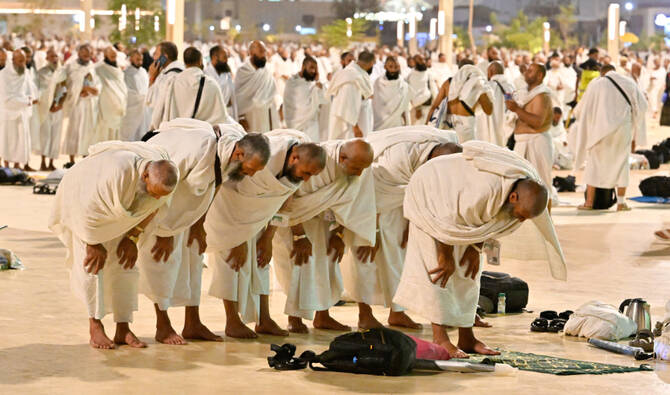
More than 1.7 million pilgrims are performing Hajj this year, the majority of whom live outside of Saudi Arabia, according to authorities in the Kingdom.
The total number of 1,707,301 is an increase of of 34,071, or 2.04 percent, compared with the 1,673,230 who attended the 2025 Hajj.
This comes amid continuing efforts to streamline pilgrimage operations, expand facilities at entry points and enhance services, officials said, and reflects the steady demand for Hajj places despite evolving regional and global conditions.
The increased attendance also underscores the Kingdom’s ongoing focus on operational efficiency, they added, particularly through the digitalization of services, improved crowd-management systems, and enhanced coordination between security, health and logistical authorities.
Figures provided by the General Authority for Statistics reveal that 1,546,655 pilgrims traveled from outside of the Kingdom to perform Hajj, while 160,646 are citizens or residents of Saudi Arabia. The vast majority of those arriving from abroad, 1,485,729, traveled by air, 54,429 entered the country through land crossings, and 6,497 arrived by sea.
The number of pilgrims who benefited from the Makkah Route Initiative, a service that allows them to complete all entry, passport and customs procedures at the point of departure and transports them directly to their accommodation, thereby avoiding long queues at airports on arrival, increased to 388,694, compared with 314,337 last year, an increase of about 23.7 percent.
The total number of people working in support of Hajj operations increased to 441,049 from 420,070 last year. However, the number of volunteers decreased from 34,540 in 2025 to 26,701, a decline of 22.7 percent.
The General Authority for Statistics said its figures were based on administrative data provided by the Ministry of Interior as the primary source, in line with a statistical framework adopted during recent Hajj seasons to ensure accuracy and reliability. The full Hajj data and detailed reports are available on the authority’s website.
source/content: arabnews.com (headline edited)
______________
The increased attendance also underscores the Kingdom’s ongoing focus on operational efficiency. (SPA)