Arabs & Arabian Records Aggregator. Chronicler. Milestones of the 25 Countries of the Arabic Speaking World (official / co-official). AGCC. MENA. Global. Ist's to Top 10's. Records. Read & Enjoy./ www.arabianrecords.org
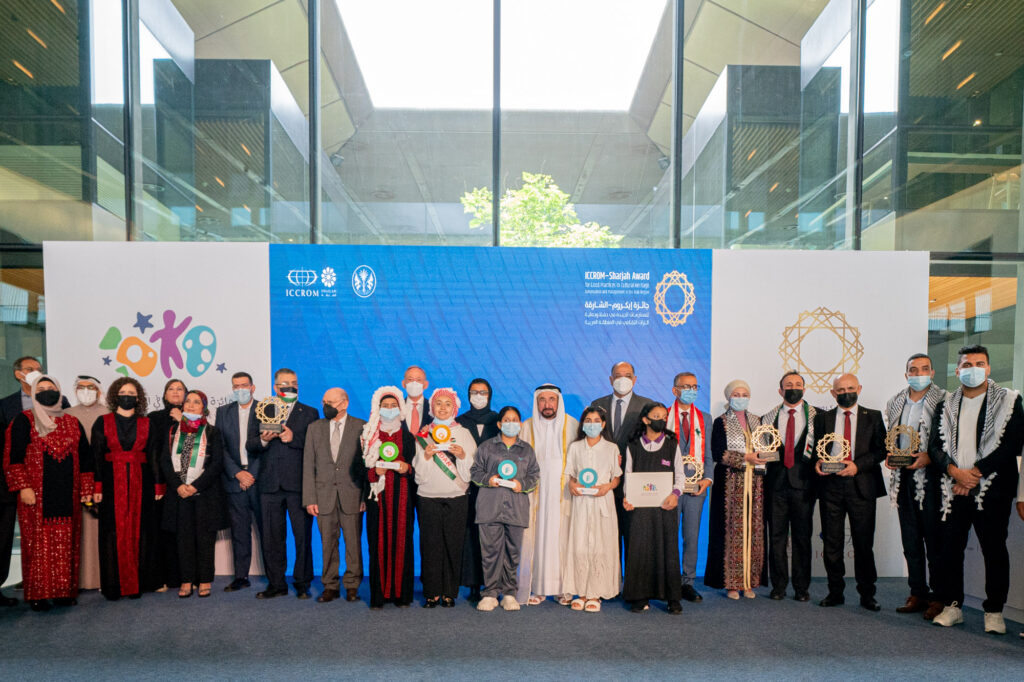
H.H. Sheikh Dr. Sultan bin Muhammad Al Qasimi, Supreme Council Member and Ruler of Sharjah, attended on Thursday an honouring ceremony of the third cycle’s winners of the ICCROM-Sharjah Award for Good Practices in Cultural Heritage Conservation and Management in the Arab Region (2022-2021), and the second cycle of the ICCROM-Sharjah Award The Arab cultural heritage for young people, in the House of Wisdom.
The ceremony began with a speech delivered by Dr. Zaki Aslan, Regional Director of International Centre for the Study of the Preservation and Restoration of Cultural Property (ICCROM) in Sharjah.
Dr. Aslan mentioned the award’s goal to spread the notion of cultural and heritage preservation in the region within international standards through initiatives and events that help exchange knowledge and experience.
Then John Robbins, Chairman of the Executive Board of ICCROM, thanked the Ruler of Sharjah, for sponsoring this event and all other activities in the region.
H.H. the Ruler of Sharjah and the audience watched several visual films about the ICCROM-Sharjah Award and the winning projects.
H.H. honored the winners of the 3rd cycle of the ICCROM-Sharjah Award for Good Practices in Cultural Heritage Conservation and Management in the Arab Region; and the 2nd cycle of the Arab Cultural Heritage Award for the Young.
The grand prize for the 3rd cycle went to Beirut Assist Cultural Heritage (BACH), a project to recover the affected area following the 2020 blast in the Port of Beirut, Lebanon; and the rehabilitation and restoration of residential courtyards and historical buildings in the vicinity of Al Aqsa Mosque, Palestine.
In the Special Excellence category, four projects won: sheltering and protecting Hicham’s Palace’s mosaic floor, Palestine; Collart-Palmyre: a comprehensive project on the Baalsahamîn temple in Palmyra; the revitalization and conservation of the cultural heritage of Al Qarara Village in Gaza, Palestine; and the digital documentation of historical documents in Jerusalem, Palestine.
As for the 2nd cycle of the Award for the Young, the student Sarah Hassan Al Hosani, from the Al Amal School for the Deaf – United Arab Emirates, and the student Al Yasar Al Masry, from the Omar Bin Al Khattab College – Al-Makassed Islamic Charitable Association – Lebanon, won first place.
The student, Ghala Abdel Rahim Mahmoud Al Raheel, from Bayouda Al-Sharqiya Mixed Secondary School – Jordan, won first place in the photography category, while the first place in the folk dance category, Al Takadum School for Basic Education – Libya, won the old street dance, and Qasr Al-Hallabat Al-Gharbi Mixed Secondary School – Jordan won first place in the awareness film category for the movie “A Story of Joy from the Heart of the Badia”.
The honouring ceremony was attended by Sheikh Salem bin Abdulrahman Al Qasimi, Chairman of the Sharjah Ruler’s Office, Sheikh Mohammed bin Humaid bin Mohammed Al Qasimi, Chairman of Department Of Statistics and Community Development, Sheikha Alyazia bint Nahyan bin Mubarak Al Nahyan, Noura bint Mohammed Al Kaabi, Minister of Culture and Youth, and several senior officials, ambassadors and representatives cultural organisations.
Torch Tower set the Guinness World Record for being the largest external 360 degree screen in the world.
Aspire Zone Foundation announced that it will officially launch the screen on June 6, 2022 between 7pm to 9pm.
Situated at 300m high and with 360° panoramic views across the city, the Torch Doha is the result of comprehensive architectural, engineering and technical design, formerly shaped to represent a colossal torch for the duration of the 15th Asian Games in 2006 held its symbolic flame.
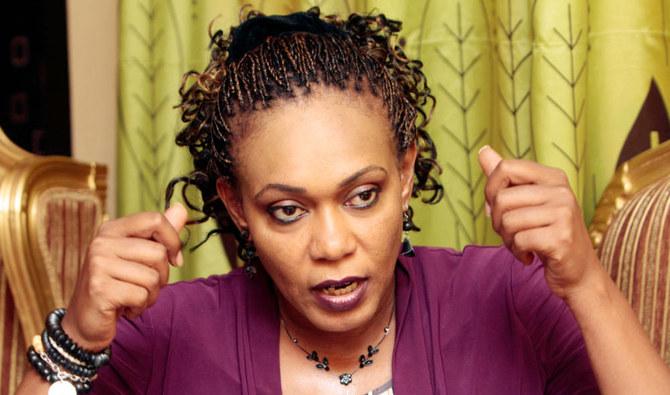
Sudanese women’s activist Amira Osman Hamed has won a Front Line Defenders Award for Human Rights Defenders at Risk, the organization announced.
The activist and engineer, now in her forties, has been advocating for Sudanese women for two decades, and was detained this year in a crackdown following the country’s latest coup.
She was among defenders from Afghanistan, Belarus, Zimbabwe and Mexico who also received the 2022 award for Human Rights Defenders at Risk.
Osman “never deterred from her mission,” Dublin-based Front Line Defenders said in its awards announcement, “consistently (advocating) for democracy, human rights, and women’s rights.”
After first being charged for wearing trousers in 2002, she drew international support in 2013 when she was detained and threatened with flogging for refusing to wear a headscarf.
In 2009, she established “No to Women Oppression,” an initiative to advocate against the much-derided Public Order Law. It was finally repealed in 2019 after Bashir’s ouster following a mass uprising.
The award has honored human rights defenders annually since 2005.
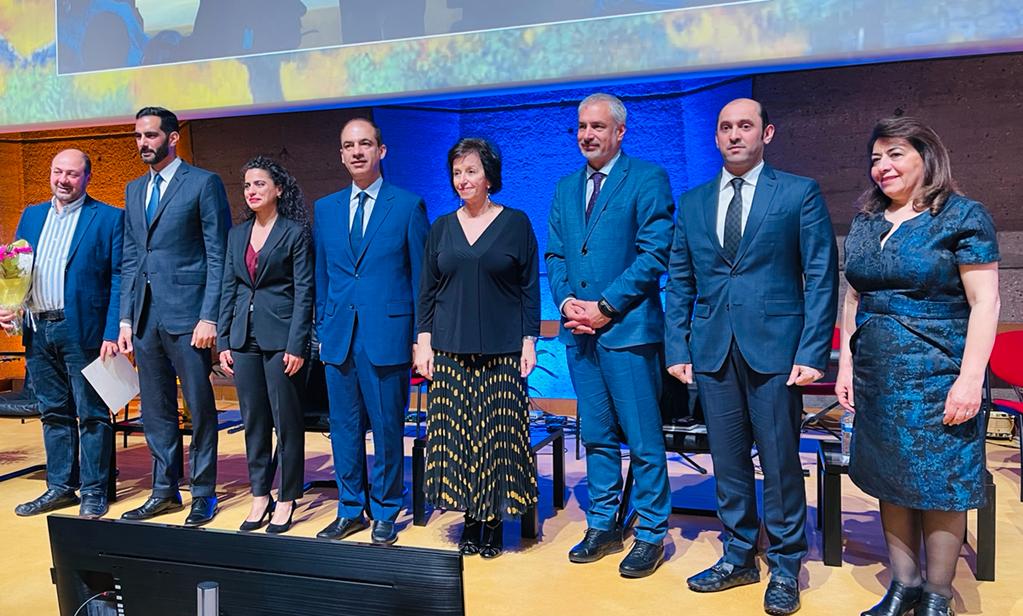
The United Nations Educational, Scientific and Cultural Organisation (UNESCO) headquarters in Paris held a ceremony for the 18th edition of the Sharjah Prize for Arab Culture (SPAC), organised by the Sharjah Department of Culture in cooperation with UNESCO.
The Prize has been awarded to Dunya Mikhail, an American-Iraqi poet, and Helen Al Janabi, a Swedish actress of Syrian-Iraqi origin.
Sheikh Salem Khalid Abdullah Al Qasimi, Deputy Secretary of State for Heritage and Arts Sector, UAE’s Permanent Representative to the UNESCO, along with Professor Mohammed Ibrahim Al Qaseer, Director of Cultural Affairs at the Department, in addition to dignitaries, writers, intellectuals and members of the diplomatic corps accredited to the United Nations.
Ernesto Otuni Ramirez, UNESCO’s Assistant Director-General for Culture, gave a speech in which he expressed his gratitude and appreciation to H.H. Dr. Sheikh Sultan bin Muhammad Al Qasimi, Supreme Council Member and Ruler of Sharjah, and for his cultural and humanitarian renaissance role at the local, regional and global levels.
Afterwards, Abdullah bin Muhammad Al Owais, Chairman of the Sharjah Department of Culture, gave a speech in which he expressed his happiness at the continuation of the UNESCO-Sharjah Prize for Arab Culture editions, appreciating the role of UNESCO in managing the prize and sponsoring many cultural programmes.
Al Owais and Ernesto Ramirez awarded the 18th Sharjah Prize for Arab Culture to Dunya Mikhail and Helen Al Janabi, in addition to honouring the winners of the 17th session.
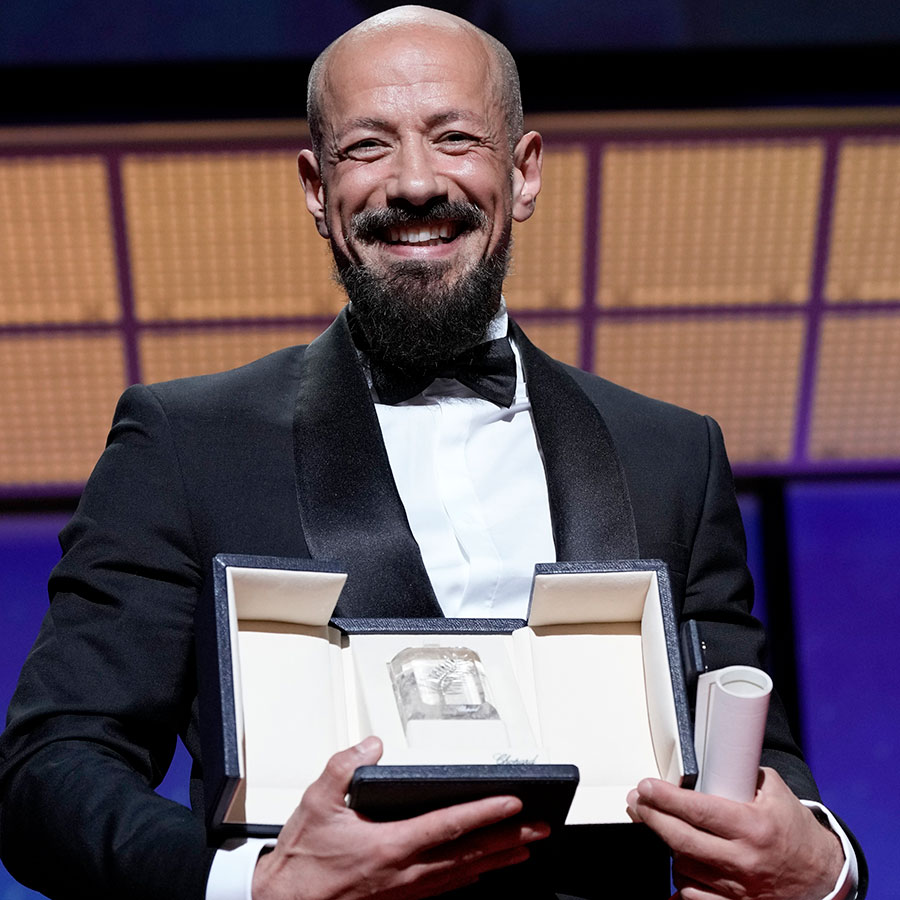
Tarik Saleh — an experienced Swedish-Egyptian filmmaker — clinched the Best Screenplay Award at the 75th Cannes Film Festival’s closing ceremony on Saturday for his latest feature film, ‘Boy from Heaven’ (‘Walad Min El-Janna’).
The filmmaker — who started his career as a journalist — also received the Prix François Chalais Award for his film’s “dedication to the values of life-affirmation.”
Boy from Heaven reportedly caused controversy amid Cannes’ Egyptian attendees after the premier, as its plot — which takes place in Al-Azhar University in Cairo — tackles the relationship between the country’s authorities and the Islamic organisation.
The film is produced by Atmo, Kristina Rikberg, and Fredrik Zander.
Previously, Saleh’s ‘Metropia’ (2009) won the Future Film Festival Digital Award of the Venice Film Festival, and his ‘Nile Hilton Incident’ (2017) — which was also set in Egypt — brought home the Grand Jury Prize from the 2017 edition of the Sundance Film Festival.
The winners of the 75th Cannes Film Festival are as follows:
– Palme d’Or: Ruben Ostlund for ‘Triangle of Sadness’ (Sweden, Germany, France, the UK)
– Grand Prix: Shared by Lukas Dhont for ‘Close’ (Belgium, the Netherlands, France) and Claire Denis for ‘Stars at Noon’ (France)
– Best director: Park Chan-wook for ‘Decision to Leave’ (South Korea)
– Best actress: Zar Amir Ebrahimi for ‘Holy Spider’ (Denmark, Germany, Sweden, France)
– Best actor: Song Kang-ho for ‘Broker’ (South Korea)
– Best screenplay: Tarik Saleh for ‘Boy from Heaven’ (Sweden, France, Finland, Denmark)
– Jury prize: Shared by Jerzy Skolimowski for ‘EO’ (Poland) and Charlotte Vandermeersch and Felix van Groeningen for ‘The Eight Mountains’ (Italy, Belgium, France, Britain)
– Camera d’Or for best first film: Riley Keough and Gina Gammell for ‘War Pony’ (The US)
– Best short film: Jianying Chen for ‘The Water Murmurs’ (China)
source/content: english.ahram.org.eg
________________
Swedish-Egyptian director Tarik Saleh poses during a photocall after he equally won the Best Screenplay prize for the film Boy From Heaven (Walad Min Al Janna) during the closing ceremony of the 75th edition of the Cannes Film Festival in Cannes (Photo: AFP)
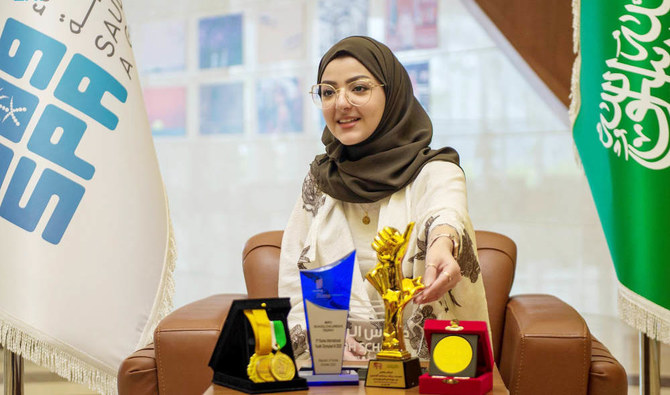
A Saudi medical student has won a string of an international awards for an invention that opens up a new world for hearing impaired or deaf drivers by dramatically improving their safety behind the wheel.
Renad bint Musaed Al-Hussein, a student at the College of Medicine at King Saud University, developed special sensors that operate as soon as they detect sounds outside the vehicle.
Sound frequencies are sent to a device inside the car, which then identifies and displays a description, image and color of the sound source visually, alerting the driver to any possible risk.
Her innovation has won several global awards and medals, including best invention at the World Intellectual Property Organization Cup and a gold award in the international invention competition as part of the Korea International Youth Olympiad.
The awards honor outstanding inventors, creators and innovative firms from around the world.
Al-Hussein said that her invention will reduce the risks facing hearing impaired drivers and may also help to save lives.
“One of the things that prompted me to come up with this invention is that some countries prevent hearing impaired or deaf people from driving because they are unable to hear important sounds. This invention will contribute to reducing the risks they face,” she said.
The Saudi inventor said that her invention could allow more than 466 million deaf people worldwide to drive, while also improving road safety by protecting their lives and the lives of others.
source/content: arabnews.com (edited)
_____________
Renad Al-Hussein said that her invention will improve road safety by protecting the lives of deaf drivers. (SPA)
Born in Larache in 1969, a young and driven Souad El Markhous found herself in a position where she had to lead a double life in Amsterdam for three years. Her struggle to grow from a young ambitious Moroccan girl to an owner of a Dutch construction company is a story that captures the listener’s heart.
Determination and perseverance were key in El Markhous’ uncanny journey, and her story reflects the resilience of Moroccan women in the face of social expectations either at home or/and beyond. Still, she conveys an overwhelming sense of gratitude. For her, her story would not have been possible without Allah (God) and rdat walidin (parental blessings).
She left Larache in 1990 to settle down with her cousin in Amsterdam without telling her father. Unfamiliar with the Dutch language and culture, she soon had to look for a job to sustain herself.
Her neighbor secured a job for her as a cleaner at the construction company De Combi, on the condition of keeping a low profile since the company was only hiring men cleaners.
Boss: from a ‘monster’ to a father-figure
Although she was afraid of getting caught, El Markhous had to clean the director’s office on Wednesday when he had a day off to spend quality time with his family.
Despite the risk of being exposed, she used to sit in the director’s office and run her fingers through the keyboard, pretending to be working there.
“I wanted to dream. I wanted to be like them, work,” she told Morocco World News.
One day her fear came true. The director, Appelman, came to the office on his day off since his children and wife went on a vacation. He entered the office and found her there. They were stunned to see each other.
From the stories she heard about him, she imagined a well-built and ruthless man who looked more like a “monster.” He met her expectations at first glance, physically at least. Yet he turned out to have a good heart and he became a father figure for her in a foreign country where she barely knew anyone.
Bucket list check
“What are you doing here?” Appelman asked Souad on that fateful day in his office. Surprised and disoriented, she tried to communicate with him in broken English and French. He quickly ordered his secretary to look for a school for her. She was aged 19 at the time. “You have to learn,” he had said.
For the following years, she secretly learned the Dutch language at Joke Smit College in Amsterdam (1990-1992) before pursuing an MBA in modern business administration at Schoevers in the University of Amsterdam between 1993 and 1996.
El Markhous pretended to work overtime to attend school, while Appelman supported her cover story.
Her father’s words after hearing about her departure and her work as a cleaner were engraved in her heart. Disappointed and sad, her father asked her if he ever mistreated her or starved her to the point that she would clean toilets for Dutch people.
These words would stay with Souad for much of her formative years in the Dutch capital, motivating her, in a sense, to do her best to make her parents proud.
Hit by reality and new beginnings
She accepted to have an arranged marriage with the hope of continuing her studies. Her future husband, also of Moroccan-descent, agreed to support her studies.
Before her departure, Appelman handed her a letter in Dutch addressed to her father. In Larache, she opened and read the letter to her father. The letter, which essentially said that Appelman was her second father in the Netherlands, reassured El Markhous’ father.
As she returned to the Netherlands, she continued her studies and gradually built up her career with the support of her husband. Now married for 20 years, they have raised two daughters together and established a happy family.
Over the years, El Markhous rose through the ranks at De Combi, moving from cleaner to telephone operator to the head of administration at the Dutch construction company. She then became a member of the workers’ council, representing her fellow colleagues who all helped her through her journey of settling and integrating into her adoptive country.
Turning point
In 2014, De Combi was on the edge of bankruptcy. At the time, the construction firm had hundreds of employees and 11 branches across the Netherlands. Four branches closed down and others were sold like in Tilburg and Amsterdam. The buyers made it clear that they would cut jobs.
Feeling responsible for protecting the familial nest she had made for herself at Combi, El Markhous was determined to find a solution to prevent the company from sinking. And buying a branch was one of the few options available.
So she decided to buy the Amsterdam branch without hesitation. But then again, not having enough money, she was faced with the impossible feat of making the acquisition within a 24-hour deadline.
Along with her husband, she started to call friends and acquaintances to collect the money. The workers also contributed with their savings. At the end of the day, she made it and saved the lives of her team members. At the time, De combi workers were unpaid for three months and had to fill in for government support.
In the following meeting of the workers’ council, she announced her ownership over the Amsterdam branch in front of 600 workers. This made her the first woman to own a construction company in the Netherlands. For the next five years, she managed the company along with the business director Willie van Dijk before establishing Markhous Beheer BV in 2019
Incomplete joy
After she bought De Cambi’s Amsterdam branch, El Markhous’ story gained tremendous public and media interest. Proud of her achievement, she collected all newspaper articles and documents that commended her work and returned home to share her joy with her parents.
“I hadn’t seen my parents for three years,” she said. Excited to reunite with her family, she entered her home to learn that her father was diagnosed with Al Alzheimer’s. “He couldn’t recognize me,” she told us with teary eyes and a shaking voice.
Souad’s father passed away in 2016, two years after that visit. Until his last moment, he was unable to recognize his daughter or learn about her success story.
In 2018, El Markhous would be awarded the Ethnic Business Woman among 45 candidates. Months later, she received the Diwan award for her inspiring story and accomplishments.
A year later, she obtained a gift of appreciation and gratitude from the Moroccan embassy in the Netherlands.
She also featured in the Dutch series “Vrouwen die Bouwen” or “women who build.” Her story was further documented by Cor de Graag in a book titled “Ondernemers zijn net mensen,” which translates into English as “Entrepreneurs are just people.” The book is based on 50 interviews with inspiring entrepreneurs in the Netherlands.
Committed to helping others
With her growing success, El Markhous has committed to helping other women to achieve their dreams. Despite her busy schedule, she has accepted numerous invitations from NGOs, schools, and other organizations to share her stories but also inspire young women to be brave and pursue their dreams.
In 2015, she received a call from a young Ethiopian woman living in the Netherlands who wanted to become an engineer. The young woman asked her over the phone to convince her father.
Later on, the father and daughter visited El Markhous’ office. The father was surprised to see her in the office of a director, particularly that of a construction company.
Souad managed to convince the girl’s father. Three years later, she received a call from the same girl who told her that she now had a job in an engineering company.
The story touched the Moroccan-Dutch entrepreneur, prompting her to commit further to supporting other women as they struggle to establish themselves in male-dominated professions in the construction or STEM sectors.
Following in the footsteps of Appelman, El Markhous is becoming the guardian angel of numerous girls and women in Morocco and Europe.
Souad El Markhous’s legacy in the Netherlands and Morocco is in the making as she aspires to invest in her home country. Her dedication, determination, and resilience can be a source of inspiration for every girl and woman around the world.
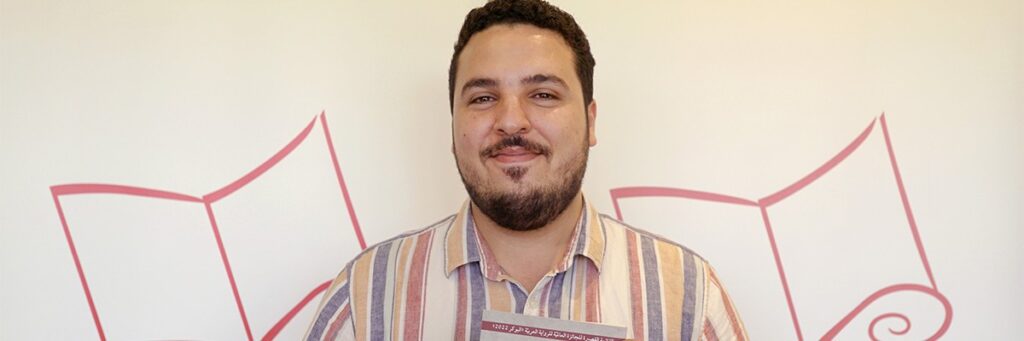
Bread on Uncle Milad’s Table by Libyan debut novelist Mohamed Alnaas was announced as the winner of the 2022 International Prize for Arabic Fiction (IPAF).
The novel, published by Rashm, was named as this year’s winner by Chair of Judges Shukri Mabkhout during a ceremony in Abu Dhabi that was also streamed online.
In addition to being awarded USD $50,000, funding will be provided for the English translation of Bread on Uncle Milad’s Table, and Mohamed Alnaas can expect to see an increase in book sales and international recognition.
Shukri Mabkhout, Chair of the 2022 Judges, said: “The winning novel is written in the form of confessions of personal experience. Its plethora of details is deftly unified by a gripping narrative, which offers a deep and meticulous critique of prevailing conceptions of masculinity and femininity and the division of work between men and women, and the effect of these on both a psychological and social level.”
He added that the novel, falls into the category of novels which question cultural norms about gender; however, it is embedded in its local Arab context, and steers away from trivial projections or an ideological treatment of the issues, which would be contrary to the relativism of fiction and its ability to present multiple points of view.
Bread on Uncle Milad’s Table is a unique story based in Libya. In the closed society of his village, Milad strives to live up to the definition of ideal masculinity, as his society views it. However, after all his best efforts, he fails to be ‘a man’, and after meeting his sweetheart and wife-to-be, Zeinab, decides to forget about this definition and be himself. Living at home, he performs the tasks which his society reserves for women, while Zeinab works and supports the family. Milad is unaware of how he is mocked in the village until his nephew breaks it to him. Bread on Uncle Milad’s Table questions static ideas of gender and champions the individual in the face of destructive ideas adopted by the majority.
Mohamed Alnaas, is a short story writer and journalist from Libya, born in 1991. He obtained a BA in Electrical Engineering from the University of Tripoli in 2014, and his short story collection Blue Blood was published in 2020. Bread on Uncle Milad’s Table (2021) is his first novel and he wrote it in just six months during lockdown and whilst Tripoli was under bombardment. He says writing the book was his “refuge from insanity” amidst the news of Covid and war.
At 34, Alnaas is the second youngest writer to win the International Prize for Arabic Fiction and the first Libyan. Bread on Uncle Milad’s Table was published with support from the Libyan Arete Foundation.
Bread on Uncle Milad’s Table was chosen by the judges as the best work of fiction published in Arabic between 1st July 2020 and 30th June 2021. It was chosen from a shortlist of six novels by authors from Egypt, Kuwait, Libya, Morocco, Oman and, for the first time, the UAE. The shortlisted finalists — Khalid Al-Nassrallah, Tareq Imam, Reem al-Kamali, Bushra Khalfan and Mohsine Loukili — will each receive USD $10,000.
The panel of five judges was chaired by Tunisian novelist, academic and previous IPAF winner (The Italian, 2015) Shukri Mabkhout. Joining him on the judging panel were Libyan doctor, poet and translator Ashur Etwebi, Lebanese writer and PEN International board member Iman Humaydan, Kuwaiti poet and critic Saadiah Mufarreh and Bulgarian academic and translator Baian Rayhanova.
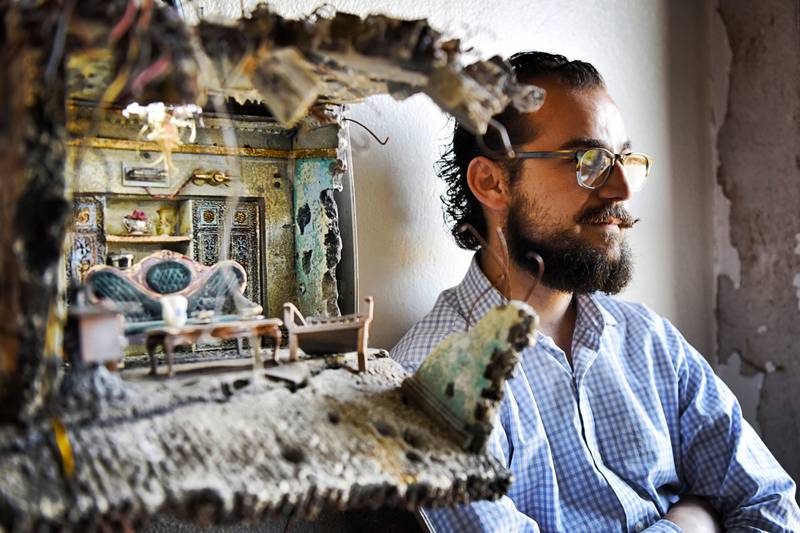
Once a creator of skyscrapers, the artist and activist has scaled-down his work – but not his ambitions – to enshrine the calamity in his homeland using elaborate models
The sound of a muezzin exhorting Muslim worshippers to hurry to salvation is not one that could often have been heard within the former Regency church of Holy Trinity in the seaside resort of Brighton.
Right on cue, though, the distinctive chant echoes out, filling every nook and cranny of the 200-year-old building, from the galleries to the arched stained-glass windows and timber-clad chancel at either end.
It comes as Mohamad Hafez is recounting the day he fell under the spell of his birthplace, Damascus, having returned to it as a teenager after a 14-year absence.
“Walking down the old city streets looking at mosques right next to churches, and synagogues next to secular galleries and nude sculptures … I went there from a very conservative culture in Saudi Arabia,” Hafez, 37, tells The National.
“Seeing the bustling city life, with merchants and calls to prayer,” he says, pausing to smile at the perfectly timed adhan issuing out of a loudspeaker hidden in one of his artworks, “and bells ringing together with children playing and the car horns, it was very hard not to fall in love with this collective celebration of diversity.”
The recording of the busy streetscape is clearly audible even over the hustle and hammering of the team assembling Hafez’s ‘Journeys from an Absent Present to a Lost Past’ exhibition in the historic residence of the visual arts organisation Fabrica.
Art handlers wearing blue surgical gloves have already carefully opened the dozen or so timber shipping crates to decant the series of miniature dioramas of his native Syria now hanging on the walls.
Each box was stencilled with FRAGILE in black lettering but the romantic snippets of memories and sounds of a bygone era contained within Framed Nostalgia #3 might arguably have warranted a more strongly worded warning.
It occupies an extra special place in the heart of Hafez — and that of his new wife, Luisa. “That’s the only piece I don’t own,” he says. “It’s owned by her, and I told the guys that if they damage it, they ruin my marriage. Anything else is fair game.”
His immersive process involves the study of photographs of Damascus from before and during the civil war, dimming the lights, brewing Arabic coffee, burning bakhour and incense, and putting on acoustic Middle Eastern music.
What emerges from the induced sentimental state as if, as Hafez puts it, he were a 3D printer are scenes of urban fabric that draw on his training as a corporate architect but come with a political charge.
“I really don’t remember much of the detail, how it comes together,” he says. “It’s a weird feeling. What I enjoy most is that I am discovering this detail as though I am a spectator seeing it for the first time, and that’s very, very fulfilling.”
Frustrated at prevailing narratives, Hafez took a sabbatical from architecture three years ago to focus fully on using his mix of street art, sculpture and activism to respond to thorny issues such as the atrocities in the ongoing conflict or dehumanisation of refugees.
“It is my foot in the door,” he says. “The more the sabbatical continues, the more I’m realising the urgency of the message and sense of agency because there are thousands of architects who can build skyscrapers , thousands.
“But how many of them are Syrian, Arab, Middle Eastern, practising Muslims, raised in Saudi Arabia, educated in the Midwest of the United States, and can talk the talk that will build bridges between people?”
Hafez says the crisis in his homeland has caused a spiritual awakening within him. Which may explain what he was doing on a three-week retreat in Malaysia when he heard news of a concert being held nearby in the capital by the ensemble Al Firdaus that he often listens to in his art studio while working.
Particularly captivated by the cellist Luisa Gutierrez, it wasn’t long before Hafez engineered a visit by Al Firdaus to Yale University, in New Haven, Connecticut, where he is a Silliman College Fellow.
He hosted the ensemble for dinner and invited them to his studio crammed full of paraphernalia, shelves and bins overflowing with scaled-down furniture and toys, dried plants and jewellery, Christmas ornaments and shells, electrical appliance innards and paints.
There, Hafez engaged all the musicians in conversation except for Luisa, who, overwhelmed by the atmosphere, was sitting on a chair staring at the artist’s latest labour of love — Framed Nostalgia #3 — and listening to the evocative audio with tears in her eyes.
“I think what happened is that she clicked into the street scene,” he says. “It’s common for people to come out crying from my exhibitions. Well, fast forward and that became her dowry for our wedding last year.”
Though Hafez was born in Syria, his own tale deviated early on when the family moved to a military compound in Al-Kharj in central Saudi Arabia, where he spent many happy hours supervising the construction of buildings out of whatever he and his playmates could lay their hands on.
Other than the lengthy commute to the elite Najd National School by bus 100 kilometres away in Riyadh, Mohamad never ventured outside the base where his father was head surgeon in the attached hospital.
“There was no need. It was a protected bubble in all respects, and really gave me a true childhood like building forts using found objects. I would boss my friends around, saying ‘No, no, this way, let’s put a window here, you see?’ Twenty years later, I’m going ‘You idiot, you’ve been doing architecture since you were 6 years old.’”
Hafez returned to his birthplace intermittently for holidays that were mostly whiled away in swimming pools, and only properly at the age of 15 when his father took early retirement.
Presided over by his sociable mother, the household became a “cultural salon” that inspired his latest architectural endeavour, Pistachio Cafe , below his studio on the northern shore of Long Island Sound.
It offers the experience of being hosted in what his domicile might have been like, transporting customers with mosaic tables and vintage radios, and bounty made by refugee chefs and cooks such as “the lady who makes shawarma for me from her kitchen at home”.
He is as entranced now with the world’s oldest continuously inhabited city as he was back then when his teenage self would wander its souqs and alleyways with sketch book in hand at any available opportunity.
But for a pupil hitherto accustomed to rubbing shoulders with the upper echelons of Saudi Arabian society, the move to a public school with military uniform and regular training exercises was shocking.
Consequently, Hafez has a deep connection to the words he has spray painted across a vast swathe of black plastic sheeting stretched around several pillars in his exhibition for the Brighton Festival.
This section of “Journeys” replicates the sense of exile felt by those in the refugee and migrant encampment known as the Calais Jungle. Above an evocative stanza borrowed from the Nairobi-born, Somali-British poet Warsan Shire — “No one leaves home unless home is the mouth of a shark” — he has put: I AM JUST A NUMBER.
“I think the whole experience at that school was so traumatic,” he recalls. “I had lost myself. No one cared about ‘What do you want to be?’ I think it’s a big part of me, who I am and why I like working with a lot of universities and high school kids, just to push that fire inside them and make them believe in their intuition.”
The result was that he undertook a course in electrical engineering at Damascus University before following his older siblings to study in the United States when it finally dawned that “every inch of my body was meant to be an architect”.
Hafez would go on to celebrate his first skyscraper at the precocious age of 30, becoming project head designer on an ambitious 48-storey glass and steel office tower in downtown Houston, Texas.
But throughout his studies, a single-entry visa precluded him from visiting Syria because of a travel ban imposed on the citizens of 27 countries after the 9/11 attacks, and later came the Arab uprisings.
Surrounded by the cornfields of Iowa, a homesick Hafez lapsed into depression and was wrought by anxiety. His way of dealing with it, as he explains in ‘A Broken House, the Jimmy Goldblum documentary about his life shortlisted for this year’s Oscars, was deciding that if he couldn’t go home then why not make home?
By night, for a long time, he modelled the destruction of Syria as a sanity-saving outlet to be able to get up and build glistening edifices in his day job with colleagues complaining about the coffee being cold. “‘This is your dilemma right now?’,” Hafez remembers thinking.
It is little wonder that he quotes with conviction the observation of Cesar Cruz, Dean of the Secondary Schools Programme at Harvard, that art should comfort the disturbed and disturb the comfortable.
“With skyscrapers, we design every last detail until the cows come home years before the building sees the light of day. With these,” he gestures around the gallery, “I can break free in my artistic expression. I don’t plan. I work on six or seven pieces at a time so as not to commit too much memory to any one piece, jumping from one to another.”
His store of memories of home is precious and finite. There is no portrait of the four siblings and parents together since 1999, the last time they were all under the same roof. He has been back to Damascus only once, just before the war began in earnest in 2011, when his architectural firm sent Hafez to pitch a project in neighbouring Lebanon.
There has been no other chance to experience the everyday occurrences or family occasions — the funeral of his beloved grandmother, the marriage of a sister, the births that made him an uncle — he has had to miss or risk enforced military service.
Yet, sustained by an inner peace, Hafez conveys hope in person and through the use of verses from the Quran in his art that are intended to counsel patience and raise spirits in dark times.
When asked to translate a particular bit of Arabic script he has incorporated into a scene, he looks gleeful. “Happiness Bakery this way 200 metres,” he explains, laughing. “People have no qualms whatsoever spray painting on a 2,000-year-old wall, putting the advertisement for their shop on a Roman column!”
The humour abounds with graffiti elsewhere saying “I love you”, “Where’s Dad?” and then there’s one in English. Again, it sets Hafez off. “It’s supposed to be ‘No parking’ but with the Arabic accent I’m making fun of our people with ‘No barking please’.”
Accents offer an endless source of amusement to him. One of the consequences of his childhood in the military compound in Saudi Arabia was picking up a multitude of Arabic dialects that Hafez employs on his travels.
“I engage people with their own native dialect, and they go, ‘Whoa, whoa, who are you?’ I love messing with Arabs because nobody can tell that I am Arab. I’m this weird object … I have this curly artist’s moustache, I have a beard, and a little [pony]tail. Then I wear a fancy shirt or a Malaysian garment, and they’re like, ‘Is he Italian? Pakistani? Bosnian? No, he’s Iranian.’”
As a master of misdirection, he concedes that he likes to sneak up on people in the same way that crises do. Audiences are lured in by the beauty of his work, such as Tower of Dreams that features intricate mosaics and floats above a tapestried rug, until the “hot moment when they realise that it looks like an RPG shooting people’s lives and memories into an abyss”.
Perhaps it is the habit of a lifelong outsider but he is also, be warned, a consummate eavesdropper, honing the skill during that side trip to Damascus from Lebanon 12 years ago.
Like a sponge, Hafez took to the streets once again, using his phone to record taxi journeys, calls to prayer, the chattering of locals in cafes that would eventually end up as the multimedia embedded in his works.
“My favourite, favourite, favourite part in everything I do is when I’m a fly on the wall,” he says. “If nobody recognises me around my exhibits, I can just eavesdrop to see how people are reacting. Or you’ll find me in Pistachio Cafe mopping floors, sweeping, putting myself at the service of people, and I observe them enjoying my product, my architectural creation.”
He ends the interview with a short guided tour of his dioramas, pointing out a pleasing crackle or patina here or some rust that has developed there, then stopping at a surveillance camera poking out of one of the facades.
“That’s Big Daddy watching always,” Hafez notes, without the slightest hint of recognition that it would be fair to say much the same of him.
‘Journeys from an Absent Present to a Lost Past’ by Mohamad Hafez is at Fabrica, Brighton, until May 29
http://www.mohamadhafez.com/
source/content : thenationalnews.com (edited)
____________
It has become an obsession in ‘undoubtedly xenophobic, divided times’ for Mohamad Hafez to use his mix of street art, sculpture and activism as a response to thorny issues such as the atrocities of the conflict in Syria or the dehumanisation of refugees. Photo: Fabrica
The friendship between a former Olympian and the college kid he took under his wing shows the power of mentoring — to make both individuals’ lives all the richer.
This story comes to you from the Star Tribune, a partner with Sahan Journal. We will be sharing stories between Sahan Journal and Star Tribune.
In Mohamed Abdi Mohamed’s childhood, Abdi Bile was like a folk hero.
“My mom told me all these stories,” says Mohamed, 26, who was born in Somalia and grew up in a refugee camp. “She told me there’s a Somali who went to America and basically conquered America.”
Bile was a world champion runner, dominating the 1,500-meter race in the late 1980s. He’s also a national legend and the most decorated athlete in the history of Somalia, where a certain make of pickup truck has been dubbed the “Abdi Bile” for its speed. In 2019, Bile quietly moved from Virginia to Minnesota to coach runners and help develop youth in Minneapolis.
But all Mohamed knew was that there was a hero living in his midst when he worked the phones in Minnesota’s Somali American community to get hold of Bile’s cell number. At the time, he was a junior at Macalester College in St. Paul and at the lowest point of his five years in the United States. Homesickness, grief and plummeting grades were leading him to question if coming here on an academic scholarship was worth it.
On a gamble, Mohamed called Abdi Bile.
Shockingly, Abdi Bile picked up.
Mohamed could hardly spit out the words as he told Bile he had just started running for Macalester’s track team — and — would the coach be interested in meeting him one day?
“If I was lucky, I would get to see him even once,” Mohamed remembers thinking.
The next day, Bile showed up at Mohamed’s doorstep in St. Paul. That encounter started a friendship that the two say will continue for the rest of their lives.
When I sat down with them near the home of the Loppet Foundation, where Bile directs competitive running programs, organizes walks for seniors, and introduces Somali American families to cross-country skiing, the 59-year-old former Olympian assured me that the story I wanted to tell — about the power of mentoring — was not just about him.
“Mohamed’s journey is very interesting, from where he started to where he is today — it’s just incredible,” Bile says. “You just see the resiliency of human beings, the struggles they go through, and how they survive if they don’t give up.”
But Bile’s story is remarkable, too. Once a teen standout soccer player, he decided on a whim to join some nearby runners who were training for the 400-meter. He beat them to the finish line, but felt so woozy afterward that he threw up.
Within a week, however, he learned two things about running: If you were good enough, you could win a scholarship to attend college in the United States — and even advance to this thing called the Olympics. When he quit the soccer team, Bile told his coach: “I’m going to the Olympics. I’m going to get a scholarship. I’m going to America. Goodbye!”
Killer workouts and his initial disdain for running did not deter Bile. “I hated it. But I just saw an opportunity: This is my way out. This is my meal ticket.”
Within just a few years, he cashed in on that ticket. He ran on an athletic scholarship at George Mason University in Virginia and competed in his first Olympics — the 1984 games in Los Angeles.
More than 35 years later, he saw echoes of himself — the dedication, the sense of purpose — when he got that phone call from the kid at Macalester.
Mohamed’s journey
Growing up in the sprawling Dadaab refugee camp in Kenya, Mohamed used to walk 4 kilometers to fetch water for his family. Whenever a blinking red light in the sky soared past, his mom used to point to the airplane and tell her son this would be his ride out of the camp.
And a scholarship was the only way to catch that ride.
With some diligence and luck, Mohamed earned a scholarship through Blue Rose Compass, a nonprofit that affords gifted young refugees a shot at a university education. It was through this gift that he was able to attend an international boarding school in New Mexico and then Macalester.
Unlike Bile, Mohamed never knew of Somalia’s idyllic beaches or peaceful past, a land rich in history and culture. He was a kid born into civil war, only to learn of his homeland’s halcyon days through stories imparted by his mom and dad.
“In their minds exists a grand country,” he says. “And at the center of this country is Coach Abdi Bile.”
“At least I had a country, a stable life,” Bile muses. “This kid just grew up in a refugee camp. What hope do you have in a refugee camp? A refugee camp is a prison. You have to do whatever it takes to get out of those four walls.”
When Mohamed first called Bile, he was on the cusp of giving up and going home. The second eldest of eight kids, he hadn’t seen his family in five years. He was mourning the death of his uncle, who was struck by a stray bullet in Mohamed’s hometown of Kismayo. His grades were slipping, and he was almost put on academic probation.
“I was starting to feel sorry for myself,” Mohamed recalls. “I was questioning the decisions I made. It feels like you’re living in a virtual reality — you have everything you need, but your family is still living in a refugee camp. I was willing to throw everything away.”
With Bile he forged the kind of connection he couldn’t find anywhere else. “What I needed was some tough love,” Mohamed says.
“He needed my help,” Bile says. “Right away, I could relate to what he’s crying for, what his issues and problems are. Sometimes it’s not a lot — sometimes the person just needs someone to talk to.”
The hardest lap
Bile told Mohamed about his first days in the United States as a college student, so poor he couldn’t cobble together the coins to do his laundry. Bile reminded Mohamed of all the people who were in his corner and invited Mohamed to Bile’s training program for elite runners so he could meet other young Somalis working toward big dreams.
“In running, the hardest is the last lap,” Bile tells me, recalling how he almost abandoned the sport because of injuries. After healing his body through yoga and acupuncture, Bile won a world championship in 1987.
“Sometimes people who quit, they don’t know how close they were to the finish line,” the coach adds.
Mohamed listened to his mentor: — Look what you came from. You’re almost there. You’re here, you’re doing it. This is nothing compared to how far you’ve traveled — and kept putting one foot in front of the other.
His internships and work-study jobs helped pave the way for his family to leave the refugee camp and find an apartment in Nairobi. His siblings now are receiving the kind of education he had only dreamed of while in the camp.
And what about the kid who came so close to throwing it all away? Mohamed graduated from Macalester in December. No one in his family could be at the ceremony, but Abdi Bile, the hero of his parents’ stories, showed up to watch Mohamed cross the stage. Bile says he wouldn’t have missed it for anything.
Mohamed is now reverse-mentoring his coach, encouraging Bile to start an Instagram account so he may ignite a spark for other young people. This week, the recent college grad also started a job as a tech analyst for a global consulting firm with offices in Minneapolis.
As the two recap the highs and lows of the past couple of years, Bile dabs his wet eyes with a carefully folded tissue.
“You did it,” he tells Mohamed. “You have a good job. You’re going to take good care of your brothers and sisters.”
The coach says he wants other young people, those who can trace a whiff of opportunity, to learn from this young man — that they should go ahead and be brave with their lives.
“Mohamed’s story is a good story for our kids here,” Bile adds.
“And so is a world champion helping his people,” Mohamed counters. “How many people can say they have the greatest athlete in the history of their country rooting for them?”
source/content: sahanjournal.com
____________
Mohamed Abdi Mohamed, right, stands for a portrait with his mentor Abdi Bile, the most decorated athlete in Somalia’s history. Bile, who directs a running program through the Loppet Foundation in Minneapolis, is coaching Mohamed not only in running but in life. Credit: Anthony Souffle | Star Tribune